
Learning often creates the expectation that one achievement will make future challenges easier. A person who learns one programming language may expect the next one to feel more familiar. A musician may assume years of practice will improve other forms of creative work. A student who becomes better at mathematics may hope to develop stronger problem-solving ability in general.
Sometimes these expectations are correct. Previous experience can provide useful knowledge, strategies, and patterns that make new tasks easier. However, skills do not automatically move from one area to another. Some abilities transfer across contexts, while others remain closely connected to the situations, tools, and experiences in which they were developed.
This process is known as transfer of learning. It describes how knowledge, skills, or habits gained in one situation influence performance in another. Researchers in psychology and education have studied transfer for more than a century because it helps explain an important question: when does learning create lasting benefits beyond the original situation, and when does improvement remain limited to the environment where it was developed?
Early transfer research explored whether improvement in one mental task could influence performance in another. Psychologist Edward Thorndike’s early studies challenged the idea that practicing one ability would automatically strengthen unrelated abilities. Later research by Mary Gick and Keith Holyoak on analogical problem solving showed that successful transfer often depends on recognizing deeper structural similarities between situations rather than simply remembering previous answers.
Together, this research changed the way educators think about learning. Transfer is not simply a matter of storing more information. It depends on whether learners can identify meaningful connections, understand underlying principles, and decide when previous knowledge should be applied.
Transfer of learning occurs when earlier experience affects later learning or performance. The effect can be helpful, harmful, or limited.
Positive transfer occurs when previous learning makes a new task easier. For example, someone who understands basic programming concepts such as variables, logic, and control structures may find it easier to learn another programming language because the underlying ideas are familiar.
Negative transfer occurs when previous habits interfere with new performance. A driver who has spent years using one traffic system may initially make mistakes when driving in a country with different traffic rules. The previous knowledge is not useless, but it must be adjusted.
Researchers commonly distinguish between near transfer and far transfer. Near transfer occurs when the new task shares important similarities with the original learning environment. Far transfer requires applying knowledge in situations that appear very different.
Near transfer is usually easier. A healthcare worker learning a new electronic record system may adapt quickly if the workflow resembles a system they already know. Far transfer is more difficult because learners must recognize deeper principles instead of simply repeating familiar actions.
This distinction explains why people can perform exceptionally well in familiar environments but struggle when the same knowledge appears in an unfamiliar form.
Skills are more likely to transfer when learners understand the principles behind them rather than only memorizing a sequence of steps.
Mathematical reasoning provides a useful example. A student who understands proportional relationships may apply that knowledge in chemistry, engineering, or economics because the same underlying concept appears in different forms. The student is not transferring a formula alone; they are recognizing a relationship that exists across multiple situations.
The organization of knowledge also affects transfer. Information connected through meaningful concepts is often easier to adapt than isolated facts because learners can identify relationships between ideas. However, understanding is only one part of skill development. Many practical abilities require extensive repetition to become accurate and reliable.
A surgeon, athlete, musician, or engineer develops expertise through repeated practice because complex performance depends on timing, judgment, and automatic responses. Transfer usually emerges from a combination of:
deep understanding of important concepts;
repeated practice that builds reliable performance;
experience applying knowledge in different situations.
A flexible skill is not simply something a person can perform. It is something they understand well enough to recognize when and where it applies.
People often assume that becoming highly skilled in one field automatically improves thinking in unrelated areas. Research suggests that expertise usually has stronger effects within the environment where it was developed.
Experts build detailed mental models through years of experience. These models allow them to recognize meaningful patterns quickly, but those patterns are often connected to specific knowledge and situations.
A professional baseball player, for example, can read a pitcher’s movements with extraordinary accuracy. That ability does not automatically make the player better at predicting economic trends or evaluating scientific evidence. The expertise is real, but it depends on specialized knowledge built through thousands of relevant experiences.
The same pattern appears in professional fields. An emergency physician may quickly recognize warning signs during a medical crisis because clinical experience has created strong pattern recognition. However, those same recognition skills do not automatically transfer to unrelated fields such as engineering failures or financial analysis.
This does not mean expertise prevents broader learning. Instead, it shows that experts must deliberately build connections between domains if they want their knowledge to transfer.
A software engineer provides a useful example. A programmer who learns one programming language does not automatically understand every technical system. The syntax, tools, and frameworks may change significantly. However, deeper concepts such as debugging methods, breaking complex problems into smaller parts, and designing logical solutions can transfer more easily because they represent broader problem-solving principles.
Successful transfer often occurs when people separate surface details from underlying structures.
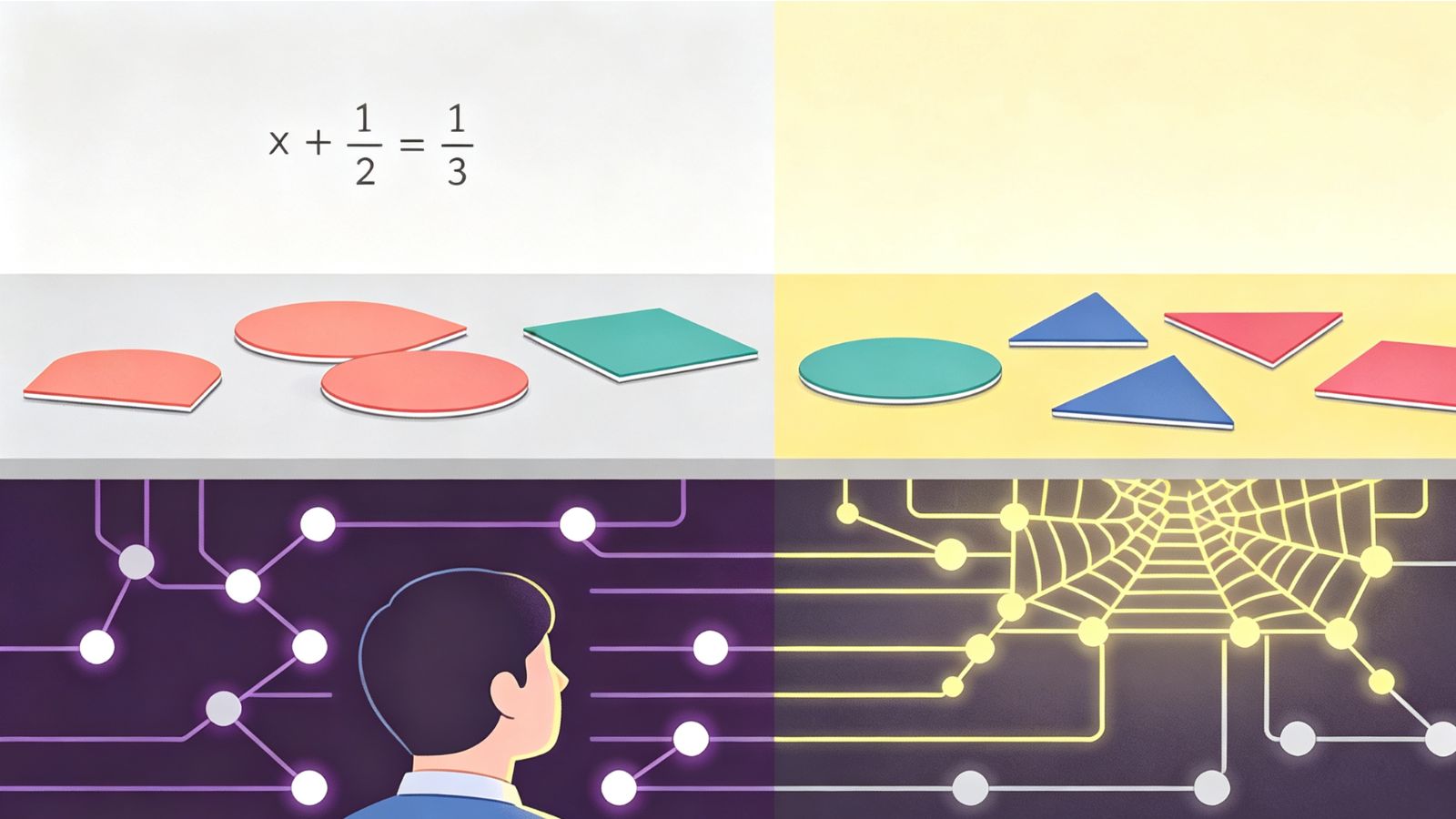
One of the most important findings in transfer research is that people may possess useful knowledge but fail to apply it when it matters.
The problem is often not a lack of information. It is a failure to recognize that existing knowledge is relevant.
For example, a student may know a mathematical formula but fail to use it when the same concept appears in a real-world problem with different wording. The student understands the procedure but has not learned how to identify situations where that procedure applies.
This challenge is closely related to pattern recognition. Experts often notice important similarities because their experience has helped them build strong mental connections. Beginners may focus on obvious surface features and miss the deeper structure.
Improving transfer therefore requires more than teaching solutions. Learners need opportunities to compare different examples, explain why a strategy works, and practice deciding when it should be used.
This is why effective learning often includes varied examples. Variation helps learners identify what remains consistent across situations and what changes.
Practice improves performance, but the conditions of practice influence whether a skill can transfer.
Repeating the same task in the same environment can create strong performance under familiar conditions. However, it may not prepare someone for unexpected changes.
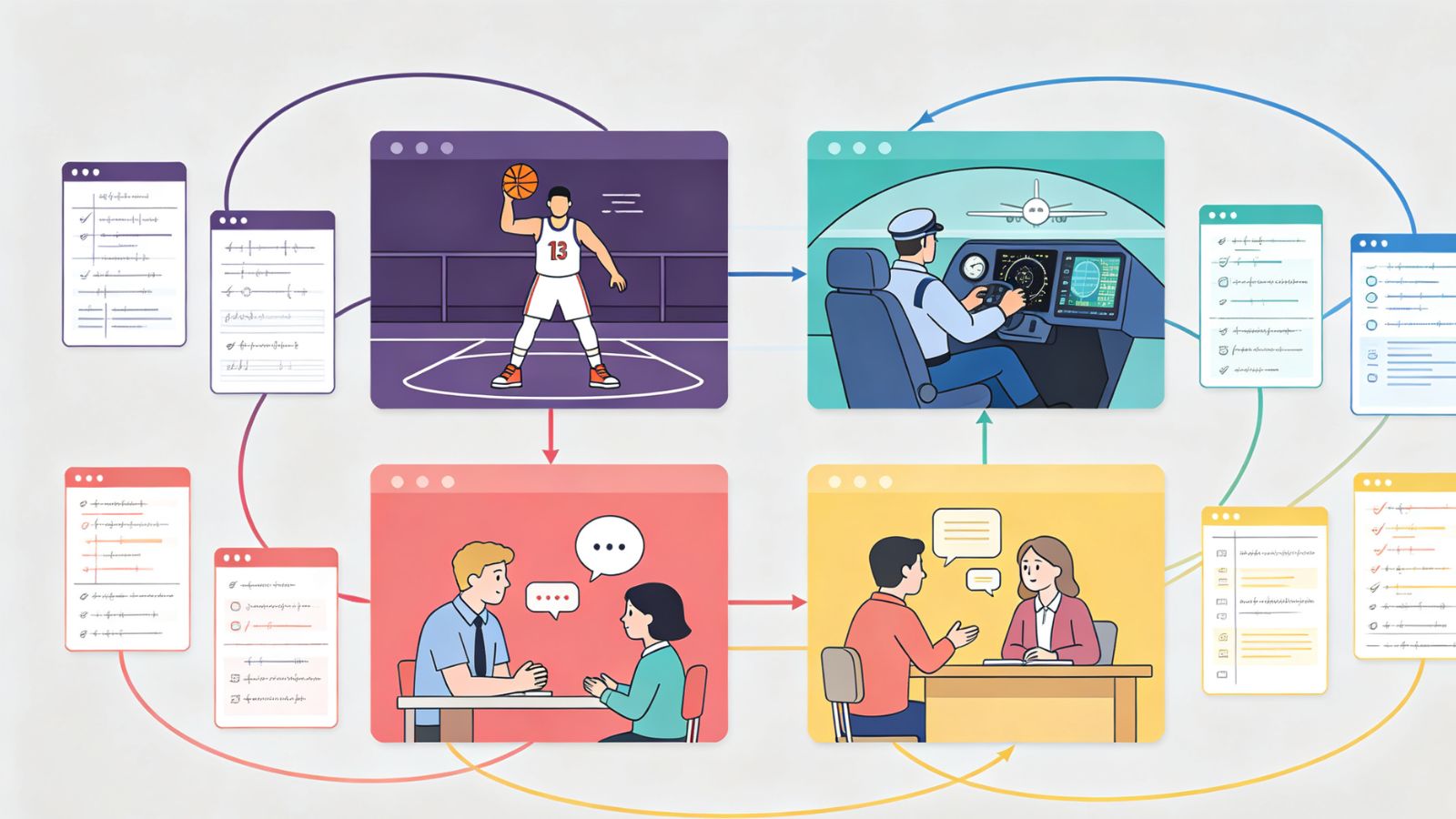
A basketball player who practices free throws only in a quiet gym may become very accurate during training but face different challenges when dealing with crowd noise, fatigue, or game pressure.
Training that introduces variation encourages flexible learning. Language learners, for example, improve transfer when they practice with different speakers, use vocabulary in multiple situations, and respond to unexpected conversations. They develop communication ability rather than memorizing fixed responses.
Professional training often follows the same principle. Pilots, medical professionals, and emergency workers use simulations because real situations rarely occur exactly as practiced.
A pilot simulator, for example, can introduce equipment failures, weather changes, and unusual conditions that require adaptation. The goal is not only to remember procedures but also to develop judgment when circumstances differ from previous experience.
Educators and organizations can improve transfer by helping learners understand not only what to do, but why a method works.
One effective approach is showing how the same idea appears in different situations. A student who learns a scientific concept through only one example may associate the idea with that specific case. Multiple examples help reveal the underlying principle.
Reflection also supports transfer. After completing a task, learners can ask:
What strategy helped?
Why did it work?
Under what conditions would it work again?
When might a different approach be better?
These questions encourage people to move beyond memorizing answers and toward understanding relationships.
Learning environments should also include opportunities for adaptation. A manager studying communication skills, for example, benefits from practicing discussions with employees, customers, and teams because each situation requires different adjustments.
Transfer research also challenges the belief that learning any difficult activity will automatically create broad improvements in intelligence or reasoning.
Certain activities can strengthen abilities related to that activity, but broader transfer is not guaranteed. Learning chess may improve skills such as planning, pattern recognition, and decision-making within chess. However, research examining whether chess training creates broad improvements in unrelated areas has produced mixed results.
The same issue appears in programs designed to teach broad abilities such as critical thinking. Critical thinking is valuable, but applying it effectively depends partly on knowledge of the subject being evaluated.
A person may understand the importance of checking evidence but still struggle to judge information in a field where they lack background knowledge. A scientist, journalist, and engineer may all use critical thinking, but each relies on different expertise to determine which evidence matters.
General skills are therefore not useless, but they are not universal solutions. They become more powerful when combined with specific knowledge.
Successful transfer usually depends on three conditions:
A strong knowledge foundation: People need enough understanding to recognize meaningful patterns.
Practice across varied situations: Different examples help learners see what remains consistent and what changes.
Awareness of appropriate use: Learners must judge whether previous knowledge actually applies.
Transfer of learning is not the simple movement of a skill from one place to another. It is a process of recognizing relationships.
The most transferable abilities are often those built on strong understanding, flexible practice, and experience across different situations. At the same time, specialized skills remain valuable because they allow people to perform at a high level within demanding environments.
A useful question after learning something new is not only:
“Where else can I use this skill?”
A better question is:
“What conditions make this skill useful, and what needs to change before it can work in another situation?”
That difference captures the real challenge of transfer. Learning creates possibilities, but successful application depends on understanding when knowledge fits—and when a new environment requires adaptation.