
Information overload is rarely caused by a shortage of things to read. The bigger problem is what happens after reading. A useful article gets bookmarked, a research paper disappears into a downloads folder, and a podcast transcript ends up buried in a note-taking app. At the time, the information feels valuable. A few months later, finding the one idea that mattered can be surprisingly difficult.
That is the problem Progressive Summarization is designed to address.
Popularized by productivity researcher Tiago Forte, the method treats summarization as an ongoing process rather than a task that has to be completed in one sitting. Instead of trying to turn every source into a polished set of notes immediately, information is refined gradually. A source can start as raw material, become easier to scan during a later review, and eventually be distilled into a short summary or a reusable idea.
The important part is not the number of layers. It is the decision to spend more effort only when the information proves worth keeping.
Traditional note-taking often creates an awkward choice. Either spend a lot of time organizing information when it is first encountered, or save it quickly and hope it can be found later.
Progressive Summarization takes a different approach. The first pass can be deliberately lightweight. Deeper processing happens later, when a project, question, or problem gives the information a reason to matter.
Forte's original framework describes several layers, beginning with the source material and progressively surfacing the parts that deserve attention. The early layers preserve context, while the later layers make the most valuable ideas increasingly easy to understand at a glance.
A practical version looks like this:
Layer 0: The original source, such as an article, PDF, book, transcript, or other reference material.
Layer 1: The useful material captured into a note for future reference.
Layer 2: The strongest words, phrases, or sentences are emphasized with bold formatting.
Layer 3: A smaller selection of especially valuable passages is highlighted.
Layer 4: The key ideas are summarized in the reader's own words, often in a short executive summary at the top.
Layer 5: For a very small number of exceptionally valuable sources, the ideas are remixed into something new, such as an article, presentation, framework, or other original work.
Not every source needs to reach the final layer. In fact, that would defeat the point.
The process starts with the source itself. That might be a long report, a web article, a collection of book highlights, or a podcast transcript.
At this stage, there is no reason to turn everything into a carefully edited summary. Preserve enough of the original material that the context remains available later.
This matters because summarization always involves judgment. A sentence that looks unimportant today might become useful when a completely different project comes along six months from now.
Keeping the original context gives later decisions a safety net.
Layer 1 is where information enters the knowledge system in a usable form. Instead of trying to summarize everything, capture the passages, observations, examples, or ideas that seem interesting or potentially useful.
The standard is intentionally loose.
A source does not have to be fully understood before it is captured. Nor does every captured passage need to become a permanent piece of knowledge. The goal is simply to prevent potentially useful information from disappearing.
For example, someone researching customer retention might save several paragraphs from a report about subscription behavior. There is no need to immediately rewrite those paragraphs into a polished theory of retention. The original material can remain intact until an actual project gives it more context.
That small distinction changes the workload considerably. Capture first. Interpret later.
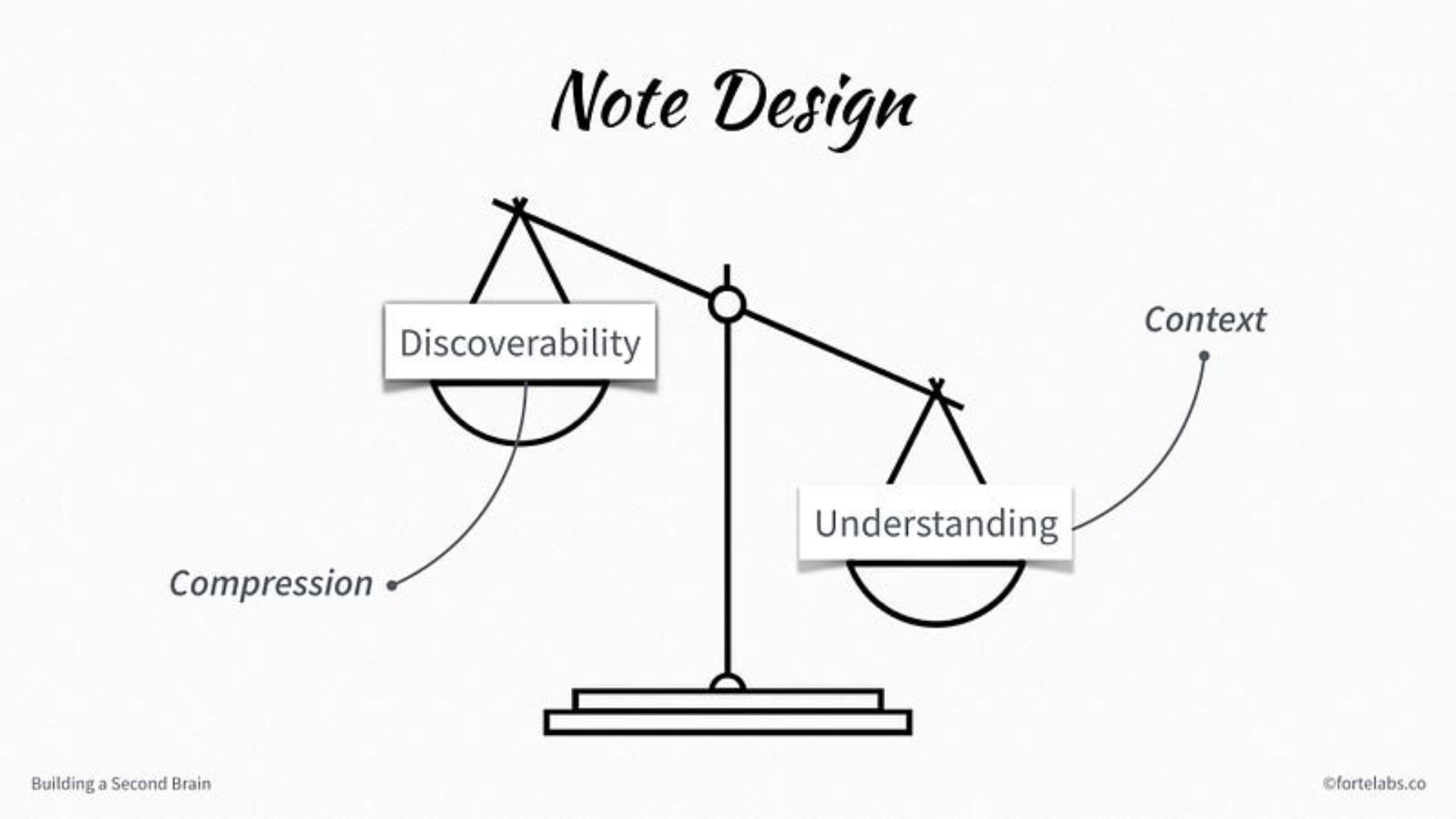
A later review is where the first real compression happens.
Rather than rereading every line, scan the material already captured and emphasize the words, phrases, and sentences that carry the most meaning. In Forte's framework, this is the bolding stage.
The purpose is simple: make the note readable at a glance.
Imagine a 2,000-word research note. If only the most important phrases are bolded, a future reader can skim the page and quickly reconstruct the main argument without starting from the beginning.
This is also where restraint matters. If almost everything is bold, the formatting has stopped doing its job. The emphasis should guide attention, not decorate the page.
Layer 3 narrows the field again.
The material that was bolded in Layer 2 is reviewed, and a much smaller number of passages receive another level of emphasis. Forte describes this as highlighting the “best of the best” within the already processed material.
Think of it as a second filter.
A useful question is: if there were only 30 seconds to review this note, which few passages would be worth seeing?
The answer should be a small subset. If nearly every bolded sentence also receives the strongest emphasis, the note has not actually become more discoverable.
This layer is especially useful for long research notes because it creates a visual hierarchy. The reader can move from the full source, to bolded material, to the handful of ideas that deserve immediate attention.
Layer 4 is where the information becomes much more personal.
For the sources that have proved genuinely valuable, write a short summary in your own words. Forte describes this as an executive summary placed at the top of the note.
This does more than save reading time. It forces a useful question: what does this source actually mean?
Suppose a 40-page industry report contains dozens of statistics, examples, and supporting arguments. A useful Layer 4 summary might reduce the report to three or four sentences explaining the central finding, why it matters, and how it relates to the project at hand.
The wording should sound like the person writing it, not like the original author.
That distinction is important. A summary copied from the source preserves information, but a summary written from understanding shows how the reader has interpreted it.
Only a small fraction of notes need to go this far.
At Layer 5, the information is no longer merely being summarized. It is being transformed. The source may become part of an article, presentation, framework, research argument, lesson, design, or another original piece of work.
Forte's original description calls this process “remixing.” The purpose is to take useful ideas and combine them with personal interpretation and creativity rather than simply repeating the source.
This is also where originality becomes especially important for published content.
Saving a useful passage and summarizing it for personal reference is one thing. Publishing a lightly rewritten version of someone else's work is another. If material from external sources is used in public content, it should be accompanied by genuine original analysis, commentary, interpretation, or other meaningful value. Google specifically warns against publishing copied or automatically generated material without substantial added value.
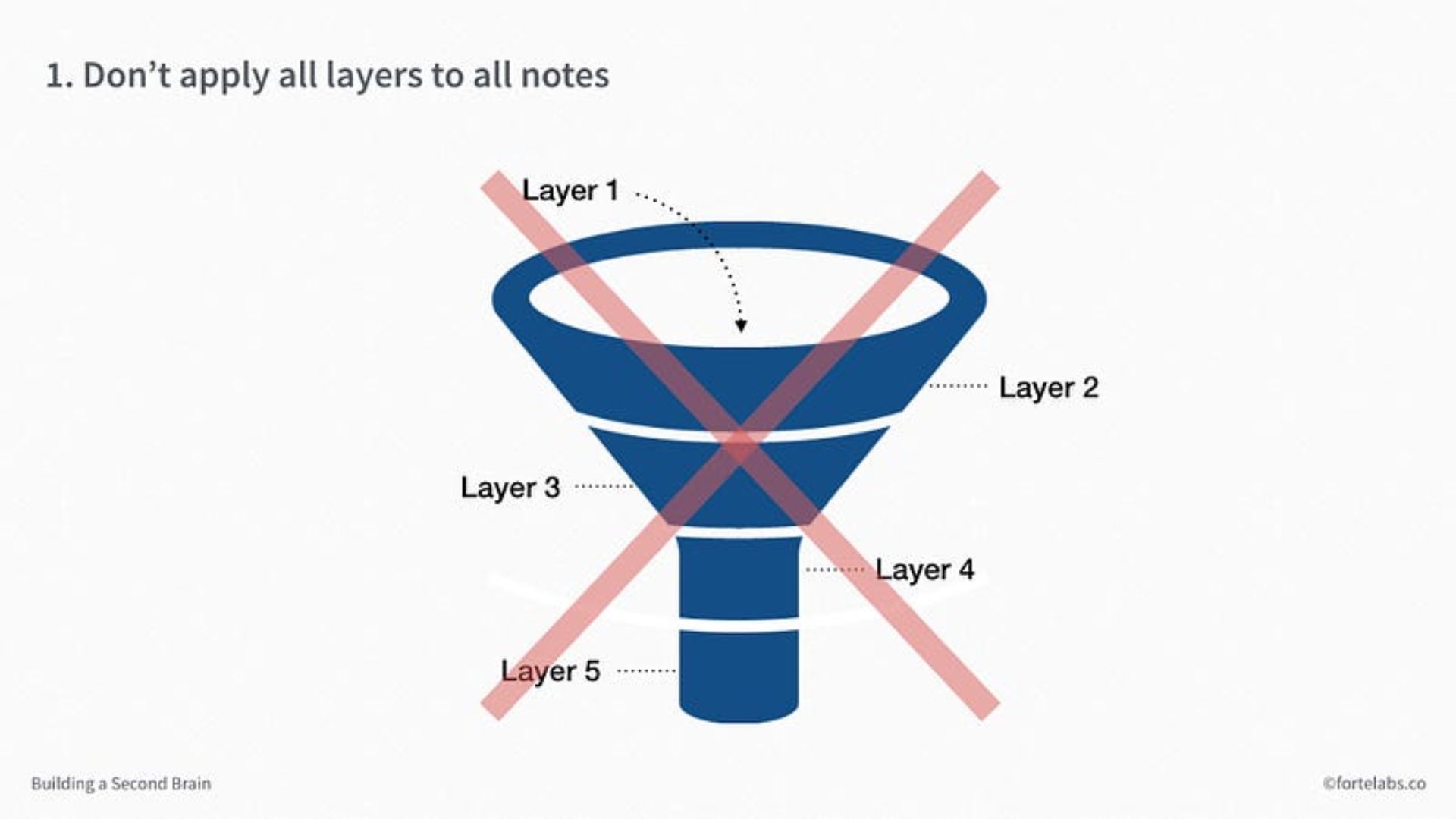
One of the easiest ways to ruin a knowledge-management system is to turn it into a second job.
Progressive Summarization is not meant to require every article, book, or transcript to pass through every layer. Forte explicitly recommends not applying all layers to all notes and focusing deeper summarization on information with greater potential value.
That principle is easy to overlook.
Consider three sources saved during the same week. One is mildly interesting. Another contains useful background information. The third directly supports a major project.
Processing all three to the same depth would waste time. The first might remain at the capture stage. The second could receive some emphasis during a later review. The third might deserve a detailed summary and eventually become part of a finished piece of work.
The system works because effort follows value.
Highlighting feels productive, which makes it surprisingly easy to overdo.
A page covered in yellow tells the reader almost nothing. If every paragraph looks important, none of it has priority.
A better test is to keep asking what can be removed without losing the main idea. When a whole paragraph seems important, look for the sentence that carries the argument. When several sentences repeat the same point, choose the one that is clearest.
The goal is not to create a colorful document. It is to reduce the amount of attention required during the next review.
Another common mistake is assuming that a good knowledge system must eventually contain a perfectly summarized version of everything.
It does not.
Some information becomes irrelevant. Some sources turn out to be less useful than expected. Some notes are captured and never revisited. That is normal.
The value of progressive summarization comes partly from allowing those low-value sources to remain shallow. Time and attention can then be reserved for material that keeps proving useful.
A knowledge base becomes more practical when it reflects real priorities rather than an artificial obligation to organize every item perfectly.
Consider someone preparing a report about remote work.
On Monday, they save a long research article because several sections look relevant. That is the capture stage.
Two weeks later, while working on the report, they revisit the article. They bold the sentences containing the strongest findings and the most useful supporting evidence.
During another review, they highlight only the few passages that directly relate to the report's central question.
Then they write a short note at the top: the study suggests that remote-work outcomes vary considerably by job type and management structure, so broad claims about remote work should be treated cautiously.
Now the source is far easier to reuse. The original evidence is still available, the important passages stand out, and the personal summary tells the future reader why the source matters.
The article has not been processed for the sake of processing it. Each additional step happened because the information had become more relevant.
The method works particularly well when information arrives faster than it can be fully processed.
Research-heavy roles are an obvious example. Analysts, writers, designers, marketers, students, consultants, and other knowledge workers routinely collect more material than they can immediately evaluate.
The challenge is not simply storage. Search can find an old document, but search alone does not tell you which three sentences matter inside it.
Progressive Summarization adds a layer of human judgment on top of storage. The archive retains the source, while successive rounds of emphasis make important information easier to rediscover.
That combination is useful because future retrieval rarely happens under the same conditions as the original reading. A source saved because it was “interesting” might later become relevant to a completely different question.
The most useful result is not a perfectly organized archive. It is reduced friction when old information becomes relevant again.
A raw document requires rereading. A document with selected passages can be scanned. A document with a concise personal summary can often be understood in seconds.
That difference adds up.
Over months and years, small amounts of processing can make an information archive considerably easier to navigate. The system does not eliminate forgetting, and it does not guarantee that every saved idea will become useful. What it does is preserve context while making the most valuable material progressively easier to recognize and reuse.
That is the real strength of Progressive Summarization: the effort is incremental, selective, and tied to actual usefulness rather than imposed on every source from the beginning.
Information overload is rarely caused by a shortage of things to read. The bigger problem is what happens after reading. A useful article gets bookmarked, a research paper disappears into a downloads folder, and a podcast transcript ends up buried in a note-taking app. At the time, the information feels valuable. A few months later, finding the one idea that mattered can be surprisingly difficult.
That is the problem Progressive Summarization is designed to address.
Popularized by productivity researcher Tiago Forte, the method treats summarization as an ongoing process rather than a task that has to be completed in one sitting. Instead of trying to turn every source into a polished set of notes immediately, information is refined gradually. A source can start as raw material, become easier to scan during a later review, and eventually be distilled into a short summary or a reusable idea.
The important part is not the number of layers. It is the decision to spend more effort only when the information proves worth keeping.
Traditional note-taking often creates an awkward choice. Either spend a lot of time organizing information when it is first encountered, or save it quickly and hope it can be found later.
Progressive Summarization takes a different approach. The first pass can be deliberately lightweight. Deeper processing happens later, when a project, question, or problem gives the information a reason to matter.
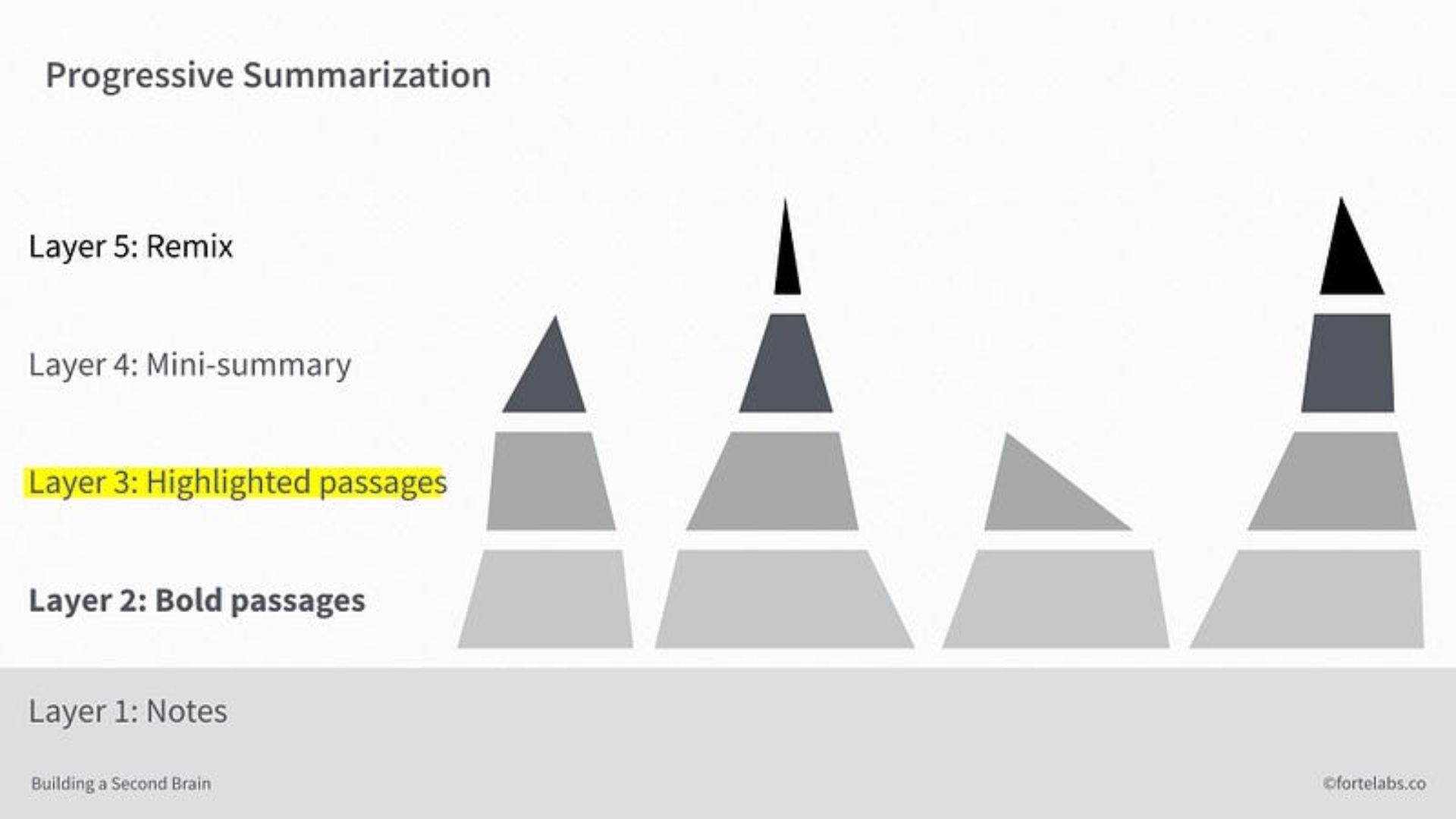
Forte's original framework describes several layers, beginning with the source material and progressively surfacing the parts that deserve attention. The early layers preserve context, while the later layers make the most valuable ideas increasingly easy to understand at a glance.
A practical version looks like this:
Layer 0: The original source, such as an article, PDF, book, transcript, or other reference material.
Layer 1: The useful material captured into a note for future reference.
Layer 2: The strongest words, phrases, or sentences are emphasized with bold formatting.
Layer 3: A smaller selection of especially valuable passages is highlighted.
Layer 4: The key ideas are summarized in the reader's own words, often in a short executive summary at the top.
Layer 5: For a very small number of exceptionally valuable sources, the ideas are remixed into something new, such as an article, presentation, framework, or other original work.
Not every source needs to reach the final layer. In fact, that would defeat the point.
The process starts with the source itself. That might be a long report, a web article, a collection of book highlights, or a podcast transcript.
At this stage, there is no reason to turn everything into a carefully edited summary. Preserve enough of the original material that the context remains available later.
This matters because summarization always involves judgment. A sentence that looks unimportant today might become useful when a completely different project comes along six months from now.
Keeping the original context gives later decisions a safety net.
Layer 1 is where information enters the knowledge system in a usable form. Instead of trying to summarize everything, capture the passages, observations, examples, or ideas that seem interesting or potentially useful.
The standard is intentionally loose.
A source does not have to be fully understood before it is captured. Nor does every captured passage need to become a permanent piece of knowledge. The goal is simply to prevent potentially useful information from disappearing.
For example, someone researching customer retention might save several paragraphs from a report about subscription behavior. There is no need to immediately rewrite those paragraphs into a polished theory of retention. The original material can remain intact until an actual project gives it more context.
That small distinction changes the workload considerably. Capture first. Interpret later.
A later review is where the first real compression happens.
Rather than rereading every line, scan the material already captured and emphasize the words, phrases, and sentences that carry the most meaning. In Forte's framework, this is the bolding stage.
The purpose is simple: make the note readable at a glance.
Imagine a 2,000-word research note. If only the most important phrases are bolded, a future reader can skim the page and quickly reconstruct the main argument without starting from the beginning.
This is also where restraint matters. If almost everything is bold, the formatting has stopped doing its job. The emphasis should guide attention, not decorate the page.
Layer 3 narrows the field again.
The material that was bolded in Layer 2 is reviewed, and a much smaller number of passages receive another level of emphasis. Forte describes this as highlighting the “best of the best” within the already processed material.
Think of it as a second filter.
A useful question is: if there were only 30 seconds to review this note, which few passages would be worth seeing?
The answer should be a small subset. If nearly every bolded sentence also receives the strongest emphasis, the note has not actually become more discoverable.
This layer is especially useful for long research notes because it creates a visual hierarchy. The reader can move from the full source, to bolded material, to the handful of ideas that deserve immediate attention.
Layer 4 is where the information becomes much more personal.
For the sources that have proved genuinely valuable, write a short summary in your own words. Forte describes this as an executive summary placed at the top of the note.
This does more than save reading time. It forces a useful question: what does this source actually mean?
Suppose a 40-page industry report contains dozens of statistics, examples, and supporting arguments. A useful Layer 4 summary might reduce the report to three or four sentences explaining the central finding, why it matters, and how it relates to the project at hand.
The wording should sound like the person writing it, not like the original author.
That distinction is important. A summary copied from the source preserves information, but a summary written from understanding shows how the reader has interpreted it.
Only a small fraction of notes need to go this far.
At Layer 5, the information is no longer merely being summarized. It is being transformed. The source may become part of an article, presentation, framework, research argument, lesson, design, or another original piece of work.
Forte's original description calls this process “remixing.” The purpose is to take useful ideas and combine them with personal interpretation and creativity rather than simply repeating the source.
This is also where originality becomes especially important for published content.
Saving a useful passage and summarizing it for personal reference is one thing. Publishing a lightly rewritten version of someone else's work is another. If material from external sources is used in public content, it should be accompanied by genuine original analysis, commentary, interpretation, or other meaningful value. Google specifically warns against publishing copied or automatically generated material without substantial added value.
One of the easiest ways to ruin a knowledge-management system is to turn it into a second job.
Progressive Summarization is not meant to require every article, book, or transcript to pass through every layer. Forte explicitly recommends not applying all layers to all notes and focusing deeper summarization on information with greater potential value.
That principle is easy to overlook.
Consider three sources saved during the same week. One is mildly interesting. Another contains useful background information. The third directly supports a major project.
Processing all three to the same depth would waste time. The first might remain at the capture stage. The second could receive some emphasis during a later review. The third might deserve a detailed summary and eventually become part of a finished piece of work.
The system works because effort follows value.
Highlighting feels productive, which makes it surprisingly easy to overdo.
A page covered in yellow tells the reader almost nothing. If every paragraph looks important, none of it has priority.
A better test is to keep asking what can be removed without losing the main idea. When a whole paragraph seems important, look for the sentence that carries the argument. When several sentences repeat the same point, choose the one that is clearest.
The goal is not to create a colorful document. It is to reduce the amount of attention required during the next review.
Another common mistake is assuming that a good knowledge system must eventually contain a perfectly summarized version of everything.
It does not.
Some information becomes irrelevant. Some sources turn out to be less useful than expected. Some notes are captured and never revisited. That is normal.
The value of progressive summarization comes partly from allowing those low-value sources to remain shallow. Time and attention can then be reserved for material that keeps proving useful.
A knowledge base becomes more practical when it reflects real priorities rather than an artificial obligation to organize every item perfectly.
Consider someone preparing a report about remote work.
On Monday, they save a long research article because several sections look relevant. That is the capture stage.
Two weeks later, while working on the report, they revisit the article. They bold the sentences containing the strongest findings and the most useful supporting evidence.
During another review, they highlight only the few passages that directly relate to the report's central question.
Then they write a short note at the top: the study suggests that remote-work outcomes vary considerably by job type and management structure, so broad claims about remote work should be treated cautiously.
Now the source is far easier to reuse. The original evidence is still available, the important passages stand out, and the personal summary tells the future reader why the source matters.
The article has not been processed for the sake of processing it. Each additional step happened because the information had become more relevant.
The method works particularly well when information arrives faster than it can be fully processed.
Research-heavy roles are an obvious example. Analysts, writers, designers, marketers, students, consultants, and other knowledge workers routinely collect more material than they can immediately evaluate.
The challenge is not simply storage. Search can find an old document, but search alone does not tell you which three sentences matter inside it.
Progressive Summarization adds a layer of human judgment on top of storage. The archive retains the source, while successive rounds of emphasis make important information easier to rediscover.
That combination is useful because future retrieval rarely happens under the same conditions as the original reading. A source saved because it was “interesting” might later become relevant to a completely different question.
The most useful result is not a perfectly organized archive. It is reduced friction when old information becomes relevant again.
A raw document requires rereading. A document with selected passages can be scanned. A document with a concise personal summary can often be understood in seconds.
That difference adds up.
Over months and years, small amounts of processing can make an information archive considerably easier to navigate. The system does not eliminate forgetting, and it does not guarantee that every saved idea will become useful. What it does is preserve context while making the most valuable material progressively easier to recognize and reuse.
That is the real strength of Progressive Summarization: the effort is incremental, selective, and tied to actual usefulness rather than imposed on every source from the beginning.