
An online course can feature exceptionally well-crafted lessons, rigorous assessments, and flawless educational technology without ever evolving into a meaningful learning community. Simply provisioning a digital discussion board or embedding a group chat channel into a course portal does not automatically generate the sophisticated interpersonal interactions that drive profound conceptual retention. Effective digital communities demand intentional architectural structure: clear, academically compelling reasons for students to participate, manageable communication patterns, proactive instructor guidance, authentic opportunities for peer collaboration, and interpersonal relationships that sustain learner motivation over the duration of a semester.
Educational researchers frequently examine these dynamics through the established Community of Inquiry framework, which conceptualizes optimal educational experiences as the intersection of three distinct forms of presence: teaching presence, social presence, and cognitive presence. Comprehensive meta-analyses of empirical studies consistently reveal positive statistical correlations between these forms of presence and student learning outcomes, with teaching presence frequently demonstrating the strongest direct relationship with actual academic mastery. The critical operational lesson for course designers is not that online curricula require an arbitrary increase in discussion volume, but rather that every interactive element must be deliberately engineered around what students are cognitively expected to learn and retain.
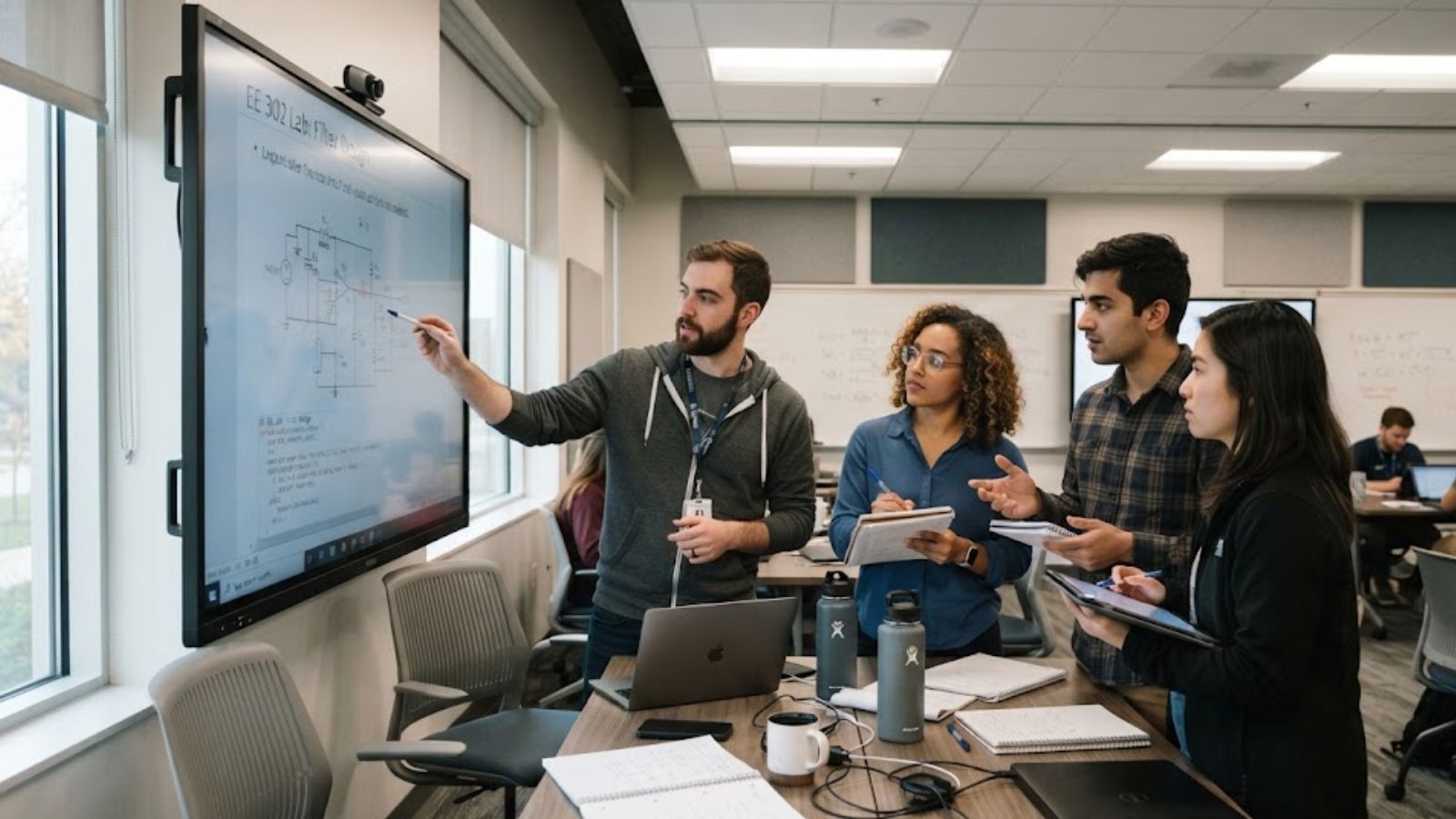
Many traditional online courses treat discussion forums as a rigid administrative checkbox: students are instructed to read a prompt, post a short initial answer, respond mechanically to two random classmates, and move on. This standardized formula predictably generates high activity volumes while producing virtually zero genuine intellectual exchange. A superior discussion module initiates with an ambiguous, open-ended problem that demands rigorous critical thinking. Students might be prompted to evaluate competing theoretical approaches, defend a complex decision using empirical evidence, identify a subtle logical flaw in a peer's argument, or apply an abstract concept to a realistic, unpredictable professional scenario.
Furthermore, the operational scale and timing of online discussions dictate their ultimate academic utility. Massive, unsegmented cohorts frequently overwhelm learners with hundreds of unnavigable posts, whereas overly diminutive groups fail to generate sufficient diversity of perspective. Instructors can mitigate these scaling failures by orchestrating smaller collaborative syndicates, rotating student facilitation roles, employing staged prompts, or introducing periodic synthesis milestones. Educational research consistently cautions against assuming that mandatory discussion frequency automatically translates into improved student achievement. When researchers compare rigid participation quotas against targeted, optional exploratory exchanges, differences in surface social presence frequently emerge while final course grades and platform satisfaction scores remain statistically unchanged. Discussion is therefore most accurately understood as a flexible pedagogical instrument rather than an educational outcome in itself.

Meaningful student collaboration materializes only when learners are given an authentic structural reason to depend upon one another. Simply instructing four students to work together on a group assignment fails to establish genuine teamwork; instead, learners routinely partition the overarching task into isolated sub-components, complete them independently, and stitch the fragmented pieces together right before the submission deadline. A robust collaborative design instead confronts the team with an authentic shared problem, a complex institutional decision, or a comprehensive group artifact that inherently benefits from multiple distinct cognitive perspectives.
This collaborative journey must feature visible, progressive milestones. For instance, student groups might first analyze a complex dataset individually, converge in a virtual workshop to debate their divergent findings, synthesize a joint organizational position, and subsequently revise their collective output following critical feedback from an instructor or peer review panel. Assigning explicit operational roles can help structure early collaborative phases, provided those roles remain fluid rather than calcifying into permanent barriers that prevent individuals from developing broader competencies. Ultimately, online collaboration must compel learners to articulate their underlying reasoning, negotiate professional disagreements, and construct consensus decisions under realistic operational constraints.

A pervasive misconception among digital educators is that establishing a vibrant online community is primarily a matter of being friendly, approachable, and lightning-fast at answering emails. While approachability is undeniably valuable, true teaching presence encompasses far less visible architectural labor, including designing the digital environment, establishing explicit behavioral norms, guiding complex peer conversations, clarifying deeply counter-intuitive concepts, and continuously tethering daily activities back to overarching course objectives.
The Community of Inquiry framework explicitly categorizes teaching presence into three core pillars: instructional design and organization, direct facilitation, and subject-matter instruction. This structural distinction is crucial because an instructor can maintain intense daily activity within a course portal—such as posting frequent announcements or answering minor administrative inquiries—without actually improving the underlying conceptual structure of the curriculum. Effective facilitation frequently involves strategic, highly selective interventions. An instructor might summarize several competing student viewpoints, surface a hidden conceptual assumption that the cohort has collectively overlooked, introduce contrasting empirical evidence that pivots the direction of a debate, or pose a probing follow-up question that pushes learners past descriptive summaries into deep analytical synthesis.

Mentorship is frequently conflated with direct classroom instruction, yet while these two educational modalities overlap, they serve fundamentally distinct developmental purposes. An instructor is primarily accountable for guiding learners through the formal curriculum and verifying mastery of specific course objectives. Conversely, an experienced mentor provides a longitudinal career perspective, helps a learner navigate professional ambiguity, shares practical tacit knowledge, and bridges abstract academic theories with messy real-world applications.
This functional distinction makes structured mentorship uniquely powerful in online educational environments, where students are largely deprived of the spontaneous, informal hallway conversations where professionals traditionally absorb unwritten industry standards. Effective online mentorship programs do not require exhausting one-to-one counseling relationships. Institutions can successfully deploy group mentoring models, scheduled virtual office hours, rotating expert panels, or peer-led mentorship circles. Structured mentoring frameworks require clear operational boundaries, ensuring mentors understand the precise scope of inquiries they are expected to handle, their weekly availability windows, and the exact protocols for referring students back to institutional academic advisors when necessary.
Ultimately, the most successful online learning environments are not defined by maximizing communication metrics, generating endless message threads, or forcing continuous, exhausting group meetings. Students frequently express a deep appreciation for a strong sense of community while simultaneously finding forced collaborativebusywork burdensome and anxiety-inducing. Course designers must therefore distinguish between superficial platform activity and deep cognitive engagement. A quiet student who spends an hour thoughtfully analyzing a complex case study may be engaging far more deeply than a peer who floods the discussion board with superficial replies.
By balancing rigorous peer collaboration, targeted instructor guidance, purposeful discussion prompts, and boundary-driven mentorship, educational designers can transform online courses from isolated repositories of digital documents into thriving, intellectually rigorous communities of inquiry.