
Artificial intelligence tutors and sophisticated adaptive learning systems are fundamentally engineered around a powerful, counter-intuitive premise: students do not all require the identical explanation, identical practice cadence, or identical questioning depth at the exact same moment in their educational journey. Instead of forcing every learner down a rigid, linear conveyor belt of standardized digital lessons, modern adaptive architectures continuously ingest telemetry data regarding a student’s real-time responses, error patterns, and progression velocity to dynamically compute what instructional intervention should happen next.
Beneath the superficial veneer of a friendly chatbot interface lies a complex technological lineage. Traditional intelligent tutoring systems have spent decades attempting to model student mastery, isolate micro-knowledge gaps, select optimal pedagogical tasks, and generate tailored feedback loops. The advent of modern generative artificial intelligence adds conversational flexibility, transforming static rule-based programs into interactive systems capable of nuanced dialogue. Groundbreaking educational research published by global policy and scientific bodies—including the Organisation for Economic Co-operation and Development (OECD) and the Institute of Education Sciences (IES)—describes this technological evolution as a seismic shift toward digital tutors capable of probing reasoning, delivering targeted feedback, and adapting instructional strategies in real time. Deconstructing how these algorithms actually function illuminates both their profound potential to democratize mastery and their inherent pedagogical limitations.
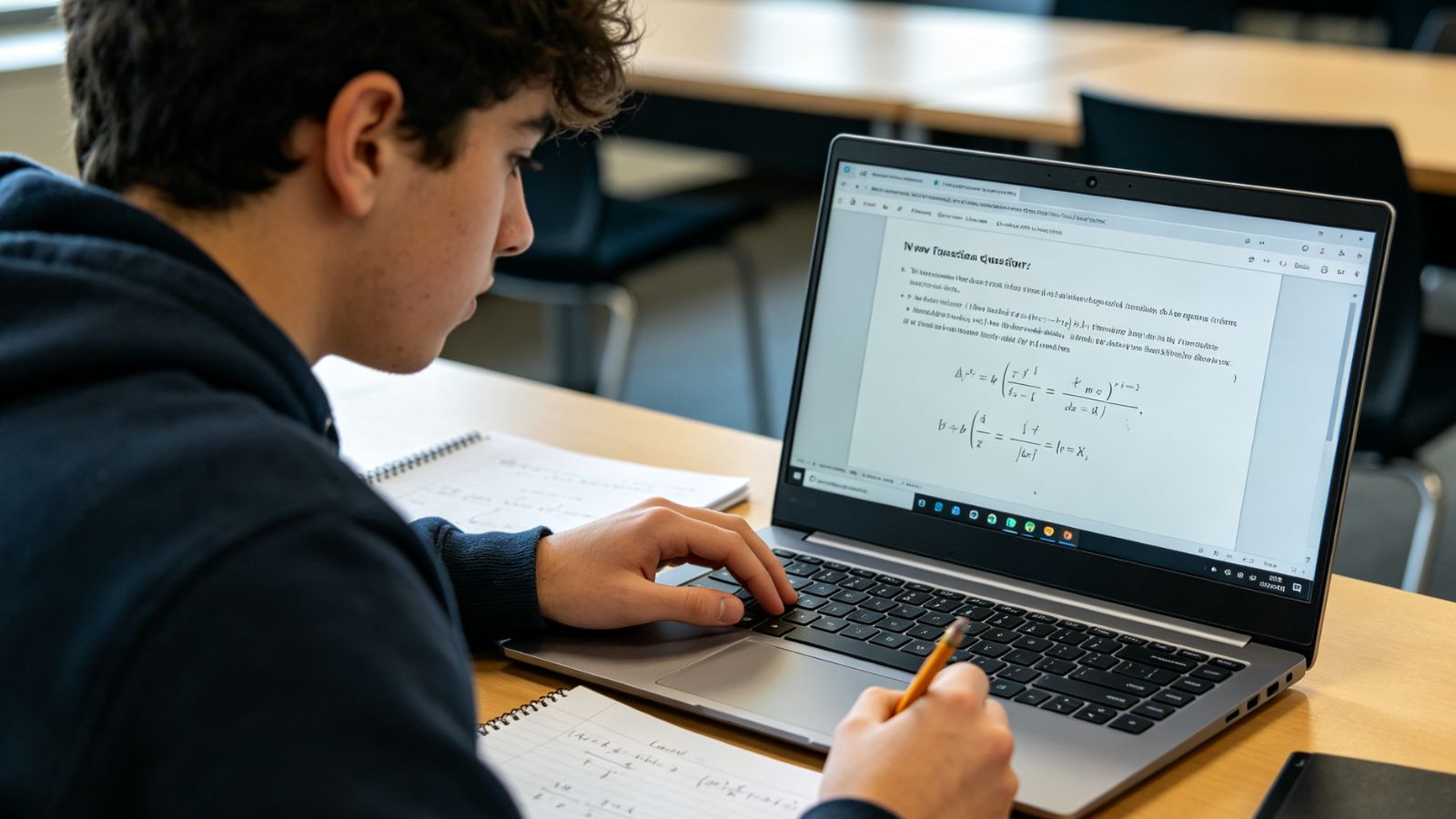
Most adaptive learning systems operate through three tightly coupled functional pillars: detecting learner behavior, diagnosing the underlying cognitive state implied by that data, and executing an appropriate pedagogical action. For instance, consider a high school student working through complex algebraic equations. If the student repeatedly commits systematic errors involving fractional manipulation while demonstrating absolute mastery over linear variables, a poorly designed software loop might simply register an incorrect final answer and dock points.
In contrast, a sophisticated adaptive architecture analyzes the precise mathematical error pattern to infer that a foundational prerequisite skill—specifically fraction operations—requires immediate remediation. The subsequent digital activity does not blindly push forward into advanced calculus; instead, it seamlessly loops back to reinforce fractional arithmetic before re-introducing the more complex problem. If the student's performance subsequently stabilizes, the algorithm advances the difficulty curve; if the conceptual misconception persists, the system pivots to deploy an alternative visual explanation or a different category of targeted practice drills.
This dynamic process depends entirely on what learning scientists define as a "learner model"—the system's internal computational representation of what it calculates the student currently understands. Different algorithms construct these cognitive models via distinct methodologies. Some architectures track binary mastery vectors across predefined curriculum nodes, while others deploy probabilistic Bayesian models to estimate the floating probability that a student has internalized a concept. Enterprise-grade adaptive systems routinely factor in response history, problem-solving latency, hint requests, and specific error typologies to maintain an exceptionally accurate profile of the learner's cognitive state.

The most immediately visible manifestation of adaptive learning is the shifting sequence of instructional activities. A conventional digital course presents every enrolled user with the exact same sequence of ten practice questions. An adaptive system, by contrast, dynamically curates a bespoke sequence tailored exclusively to the individual's live performance metrics.
This selection algorithm sits at the beating heart of the adaptive experience. The system constantly evaluates whether a candidate question tests an unmastered competency, whether its difficulty coefficient matches the student's current zone of proximal development, and whether a foundational prerequisite requires reinforcement first. Furthermore, adaptive assessment algorithms accomplish two distinct objectives simultaneously: they measure performance validity while instantly dictating the subsequent instructional move.
The ultimate objective of this algorithmic routing is never to artificially flatten assignments or make every question effortlessly solvable. An effective adaptive platform carefully maintains an optimal level of cognitive challenge. Serving a student exclusively comfortable questions generates inflated completion rates without fostering genuine intellectual growth, while inundating a struggling learner with problems far beyond their current comprehension breeds frustration and abandonment. The algorithm's core mandate is charting a productive pedagogical pathway between those two extremes.

Generative artificial intelligence fundamentally revolutionizes the interaction layer of personalized education. Earlier generations of intelligent tutoring systems operated strictly within heavily restricted subject domains governed by rigid decision trees and predefined multiple-choice response types. Modern generative AI tutors can conduct open-ended Socratic dialogues, pose probing follow-up questions, rephrase complex theoretical explanations on the fly, and respond intelligently to natural-language student inquiries.
This conversational agility bridges the gap between software and human-like mentorship. A student struggling to grasp cellular respiration can ask for a biological analogy, request a simplified step-by-step breakdown, or articulate their confused reasoning in conversational prose, prompting the system to generate an immediate, contextualized reply. The OECD highlights this exact capability, noting that generative AI empowers intelligent tutoring systems to transcend rigid scripts in favor of dynamic dialogue-based interactions characterized by strategic questioning, gentle nudging, and real-time instructional pivoting.
However, conversational fluency must never be confused with absolute educational accuracy. A large language model can articulate a deeply convincing, eloquently phrased explanation that contains a subtle factual error, misinterpret a nuanced student question, or provide assistance that is either toxically advanced or patronizingly simplistic. Consequently, robust educational platforms require far more than an underlying language model; they demand rigid instructional guardrails, vetted curriculum content, automated validation mechanisms, and structural safeguards that keep the interaction anchored to explicit learning outcomes.

Early adaptive systems concentrated myistically on narrow knowledge and skill gaps. Contemporary educational engineering, however, expands algorithmic focus to encompass non-cognitive behavioral dimensions, including metacognitive self-regulation, motivational persistence, task engagement, and behavioral pacing.
This expansive data collection creates powerful opportunities while introducing profound design dilemmas. A system may observe that a student requires significantly longer to solve a geometry proof or repeatedly clicks for automated hints, but raw telemetry cannot inherently decode why those behaviors occurred. The student might be deeply engaged in rigorous problem-solving, severely distracted, fatigued by late-night study sessions, struggling with a clunky user interface, or grappling with external personal stressors.
This irreducible ambiguity explains why human oversight remains irreplaceable. While algorithms excel at detecting statistical patterns across millions of data points, interpreting the human context behind those patterns requires genuine emotional and pedagogical intelligence. Professional educators provide vital contextual awareness that remains invisible to lines of code, determining when a struggling learner requires emotional empathy and encouragement rather than simply another algorithmically generated practice set. Consequently, the most powerful educational models are explicitly hybrid, combining the computational scalability of artificial intelligence with the empathetic judgment of human teachers.
Rigorous educational research confirms that intelligent tutoring and adaptive systems can measurably accelerate learning gains under specific conditions, yet the data delivers no blanket endorsement for every software platform bearing an AI label. Empirical evaluations funded by institutions like the Institute of Education Sciences reveal significant performance variations across randomized control trials, with some implementations yielding profound mathematical and literacy gains while others demonstrate negligible impact.
The ultimate efficacy of these technologies depends entirely on pedagogical implementation. Research published in recent educational outlooks cautions against the phenomenon of cognitive outsourcing, wherein students utilize general-purpose AI chatbots to effortlessly generate answers, producing impressive immediate productivity at the direct expense of long-term skill retention. Educational artificial intelligence designed around explicit, rigorous learning objectives forces students to wrestle with difficult concepts rather than bypassing cognitive friction, ensuring that technology serves as a scaffold for genuine intellectual independence.