
Building effective training is not just a matter of choosing a popular instructional design model. The harder question is whether the model fits the project.
A compliance course with fixed requirements has very different needs from a software training program that changes every few weeks. A university curriculum built over several years also presents a different challenge from a short internal training module that needs to be tested with learners almost immediately.
Four approaches are particularly useful for thinking through these situations: ADDIE, the Successive Approximation Model (SAM), Agile approaches to learning design, and M. David Merrill's First Principles of Instruction. They should not be treated as interchangeable frameworks. ADDIE and SAM describe ways of organizing design work, Agile introduces an iterative way of managing development, and First Principles focuses on the quality of the learning experience itself.
Understanding that distinction makes the choice much easier.
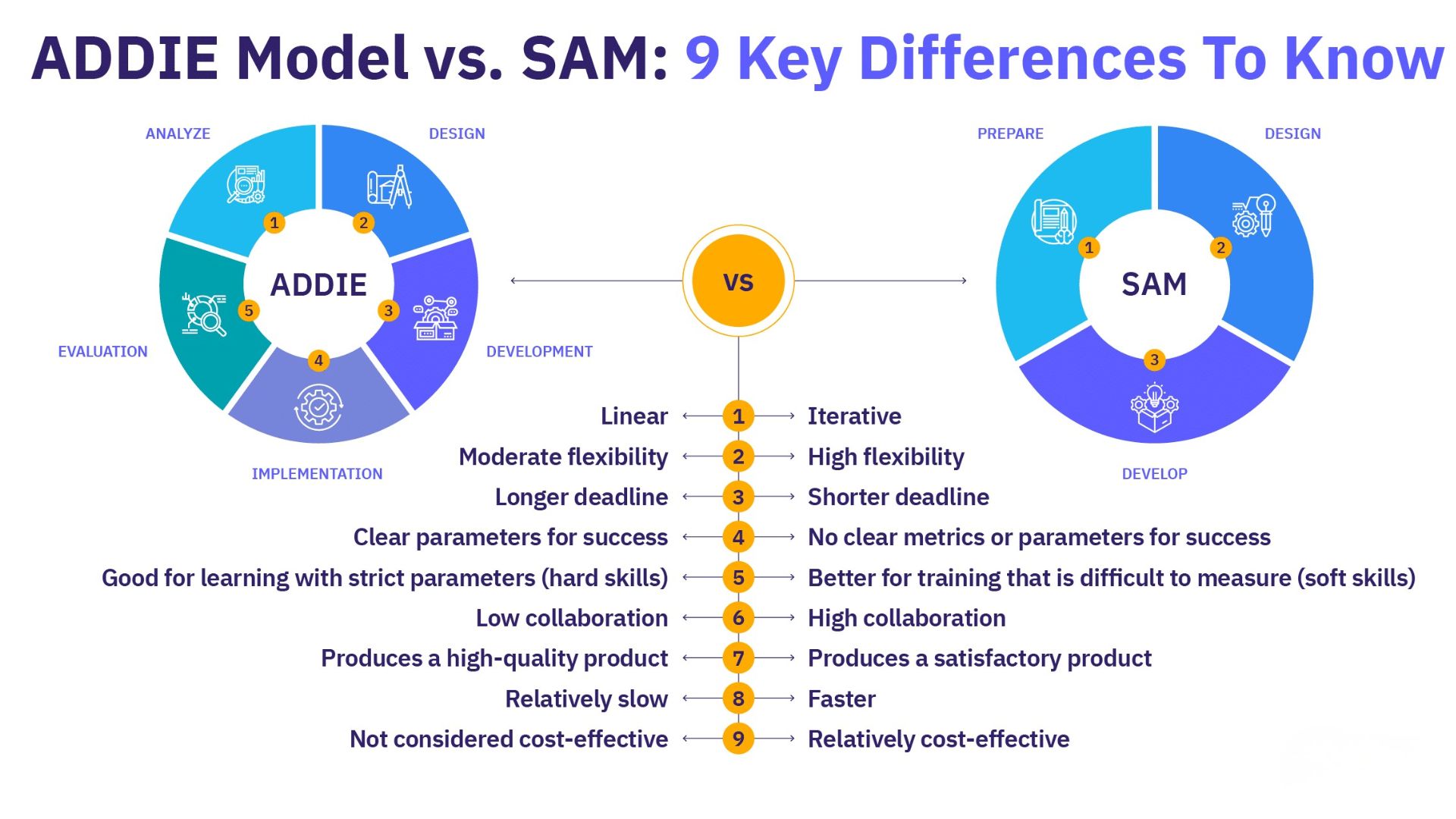
ADDIE is one of the best-known models in instructional design. The name refers to five activities: Analysis, Design, Development, Implementation, and Evaluation.
The model grew out of instructional systems development work associated with U.S. military training and educational research in the 1970s. Over time, ADDIE became a widely used way to organize instructional design projects across education, government, and corporate training.
The appeal is straightforward: before building a course, the team spends time understanding the learners, the performance problem, the learning objectives, the delivery environment, and the resources available. Those findings inform the design, which then guides development and implementation.
ADDIE is often illustrated as a sequential process, but real projects do not have to follow it as a rigid one-way pipeline. Teams may return to an earlier phase when evaluation reveals a problem or when requirements change.
ADDIE is particularly useful when the project has clear requirements and the cost of getting the design wrong is significant. Regulatory training, standardized procedures, and large programs with defined learning objectives can benefit from its emphasis on analysis and documentation.
That structure also creates a useful record of how decisions were made. If several people or departments are involved, documented objectives, assessments, and design decisions can make coordination much easier.
The trade-off is speed. A team that spends too much time trying to finalize every detail before testing anything can discover problems later than it should. A change in the target audience, technology, or business requirement may also force earlier decisions to be revisited.
ADDIE, then, is best viewed as a disciplined framework for organizing the work—not necessarily a rule that every decision must be locked before the next step begins.
The Successive Approximation Model, commonly known as SAM, takes a different approach. Developed by Michael Allen and associated with Allen Interactions, SAM emphasizes iteration, collaboration, and early prototypes.
Instead of attempting to define every detail before showing stakeholders what the learning experience will look like, the team creates an initial version and uses feedback to improve it.
The exact prototype might be rough. It could be a sample interaction, a short lesson, a screen sequence, or another representative piece of the course. The important part is that stakeholders have something concrete to react to.
That changes the conversation.
It is much easier for someone to say, “This activity doesn't reflect how our employees actually work,” when they can see the activity than when they are reviewing a long design document.
SAM can be particularly useful when requirements are uncertain or when stakeholders cannot fully explain what they want until they see an example.
Software onboarding is a good case. The product may change during development, and subject matter experts may discover missing scenarios only after interacting with the first version. An iterative process gives the team room to respond.
The main risk is uncontrolled revision. Iteration does not mean every suggestion must be incorporated. Without clear priorities, decision-making authority, and review points, a project can spend too much time polishing minor details.
SAM therefore works best when iteration is paired with boundaries.
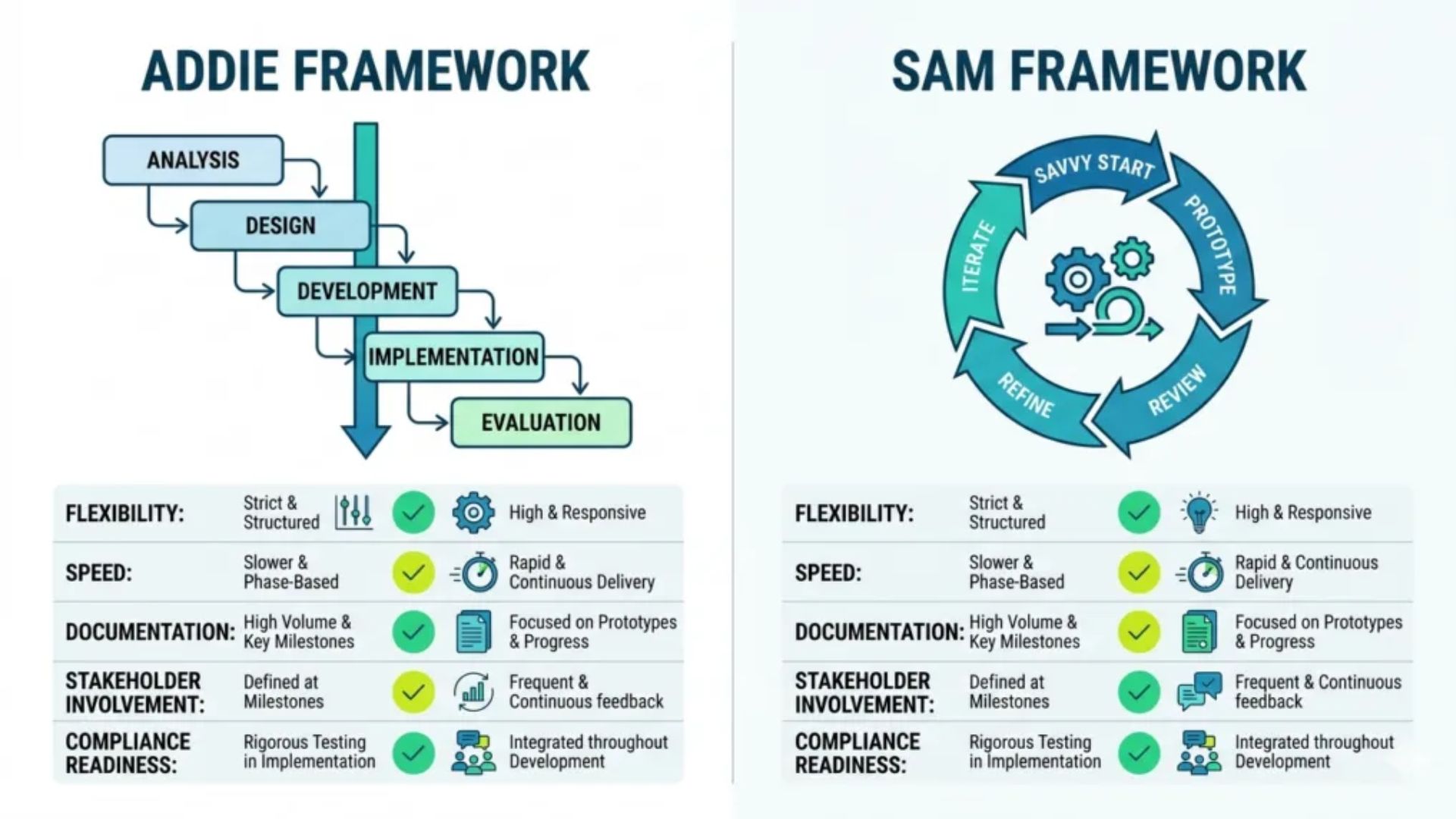
Agile instructional design borrows ideas from Agile software development and adapts them to learning projects. Rather than treating the entire course as one large deliverable, the team divides the work into smaller increments and develops them through short, time-boxed cycles.
A sprint is one way of organizing those cycles. During a sprint, instructional designers, subject matter experts, developers, and other contributors work on a defined set of learning components. The results can then be reviewed, tested, and used to determine what should happen next.
The important distinction is that Agile is not simply “ADDIE, but faster.”
Agile changes how the team collaborates and manages the work. Cross-functional contributors may work together throughout development instead of handing completed artifacts from one department to another. Priorities can be adjusted as new information appears, and feedback becomes part of the development rhythm rather than something reserved for the end.
Agile approaches are especially useful when a learning product will evolve continuously.
Consider a digital learning platform supporting a large professional program. New modules may be added over time, learner data may reveal weak areas, and business requirements may shift. Trying to design the entire experience years in advance would create unnecessary constraints.
Agile can also make sense for large projects with multiple contributors, provided the organization can support frequent communication and quick decisions.
That last point matters. Agile is not a shortcut around project management. It requires discipline, prioritization, and a team that can collaborate consistently. Without those conditions, frequent iteration can create confusion rather than flexibility.
M. David Merrill's First Principles of Instruction belongs in a different category from ADDIE, SAM, and Agile.
It does not tell a team how to schedule development or manage a project. Instead, it provides a way to think about what makes instruction effective.
Merrill organized the principles around five elements:
Task-Centered: Learning is organized around meaningful tasks or problems rather than isolated information.
Activation: Existing knowledge or experience is brought to the learner's attention as a foundation for new learning.
Demonstration: New knowledge or skills are demonstrated through appropriate examples or representations.
Application: Learners have opportunities to practice what they have learned.
Integration: Learners connect the new knowledge or skill to their own work, experience, or future use.
This makes First Principles useful alongside other design approaches.
For example, an instructional designer could use ADDIE to organize the overall project, Agile practices to manage development cycles, and Merrill's principles to examine whether each learning activity gives learners enough opportunity to observe, practice, and apply the target skill.
That combination is often more useful than treating instructional design models as mutually exclusive choices.
The differences become clearer when the three approaches are viewed through the lens of project conditions.
ADDIE emphasizes structured analysis and design. It is a strong fit when requirements are reasonably stable and documentation, consistency, and deliberate planning matter.
SAM emphasizes rapid approximation and repeated feedback. It becomes attractive when stakeholders need to see working examples before they can give useful feedback.
Agile emphasizes continuous delivery and cross-functional collaboration. It is particularly helpful when the learning product will continue changing and development needs to happen in small increments.
The choice therefore does not have to be ideological.
A team might use ADDIE to establish the overall learning strategy, borrow SAM's prototype-driven approach during design, and use Agile practices to organize ongoing development. First Principles can then provide an additional check on whether the resulting instruction actually supports meaningful learning.
The best approach is often a combination rather than a single label.
Framework or ApproachPrimary FocusGood FitMain ChallengeADDIEStructured analysis, design, development, implementation, and evaluationStable requirements, regulated or standardized training, complex programsCan become slow when treated as a rigid sequenceSAMPrototyping, collaboration, and iterative refinementProjects with uncertain requirements or frequent stakeholder feedbackPoorly controlled iteration can create scope creepAgileIncremental delivery, collaboration, and adaptationContinuously evolving digital learning products and large collaborative projectsRequires strong communication and decision-makingFirst PrinciplesLearning effectiveness and problem-centered instructionImproving the instructional quality of courses built with any processDoes not provide a project schedule or development workflow
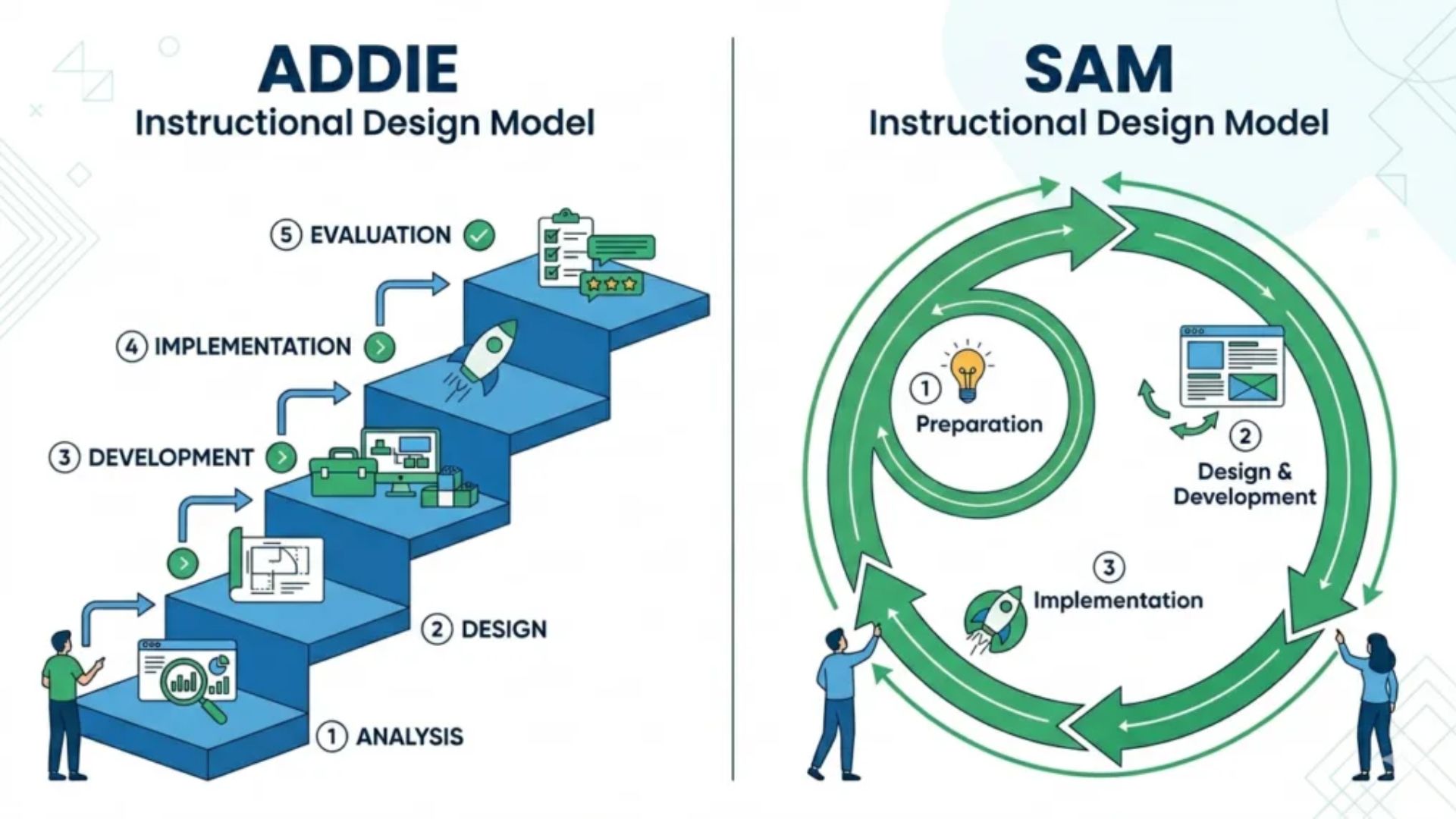
A few practical questions can narrow the decision quickly.
Are the requirements stable? If the objectives, audience, technology, and content are already well defined, ADDIE may provide the structure the project needs.
Do stakeholders need to see the learning experience before they can give useful feedback? If so, SAM's emphasis on early prototypes may be more effective.
Will the content change continuously? An Agile approach can make more sense when new requirements, learner data, or product changes are expected throughout development.
Is the main concern learning quality rather than project workflow? Merrill's First Principles can be applied regardless of which development process the team chooses.
There is also a fifth question worth asking: How much change can the organization realistically handle?
A theoretically flexible model is not automatically the best choice. If subject matter experts are rarely available, stakeholders cannot review prototypes promptly, or the team has no mechanism for prioritizing changes, an iterative process may create more friction than it solves.
The framework has to fit the organization as well as the course.

There is no universal winner among ADDIE, SAM, Agile, and First Principles because they solve different problems.
ADDIE provides a structured way to think through a complete instructional project. SAM puts early prototypes and feedback at the center of design. Agile organizes development around smaller increments and continuous adaptation. First Principles shifts the focus back to the learner, asking whether the instruction actually helps people solve problems, practice skills, and transfer what they have learned.
That is why choosing an instructional design approach should start with the project rather than the model. Look at the stability of the requirements, the pace of change, the availability of stakeholders, the complexity of the team, and the nature of the learning goal. Then choose the process—or combination of processes—that fits those conditions.
A good framework should make the work clearer. It should not become another constraint the team has to work around.