
We have all experienced the frustration of lost context. You search an old hard drive or a forgotten cloud folder for a project brief, research note, or technical decision from five years ago. Eventually, you find it. Then comes the second problem: the file depends on software that no longer exists, uses a format that is difficult to open, or sits somewhere inside a folder structure that made perfect sense at the time but now tells you almost nothing.
Many personal knowledge systems are designed around short-term productivity. They are good at collecting today's ideas, tasks, links, and meeting notes, but they are not necessarily designed to preserve useful knowledge over an entire career. That distinction matters. A person's work can change dramatically over twenty or thirty years, moving from hands-on execution to management, strategy, consulting, research, or a completely different field. A system built around one job title or one software product can become awkward as soon as that context changes.
A durable knowledge system needs a different foundation. The goal is not to predict exactly how information will be used decades from now. It is to store ideas in a form that remains readable, searchable, understandable, and easy to reorganize as circumstances change.
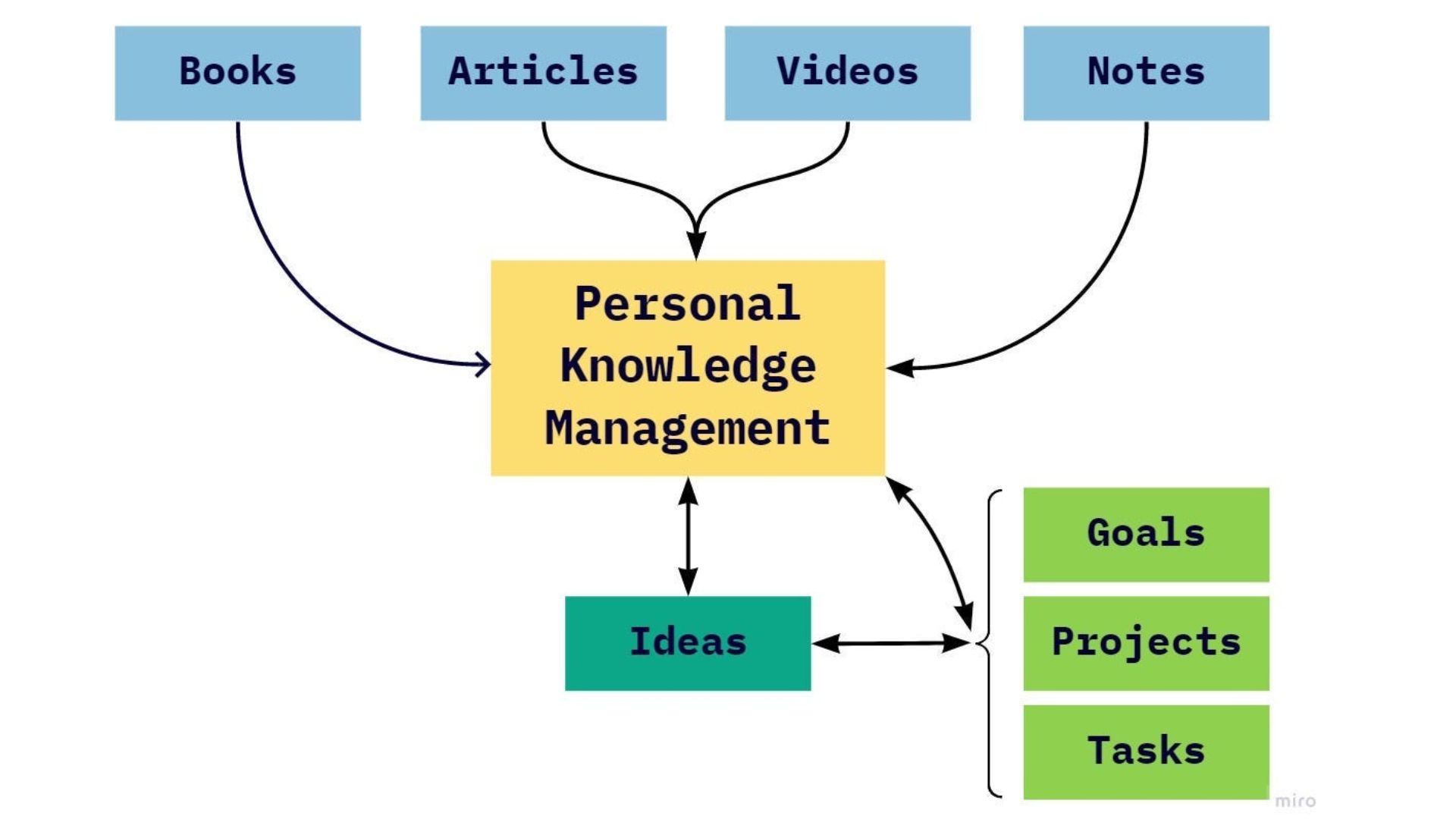
One of the biggest long-term risks is tying valuable information too closely to a particular application. Software products change. Companies shut down services, redesign their products, change pricing, introduce new storage formats, or get acquired. A note-taking application that feels essential today may look very different several years from now.
That does not mean modern knowledge-management tools are bad choices. They can be extremely useful. The problem comes when the application becomes the only place where the information exists.
For a long-lived personal archive, plain text is a strong foundation. Markdown is particularly practical because it adds simple formatting conventions to ordinary text without requiring a proprietary database. A Markdown file can be opened and edited with many different applications, which makes the underlying content easier to move when software preferences change.
The useful principle is simple: separate the information from the interface used to access it.
A note-taking application can provide search, backlinks, graphs, synchronization, templates, and other conveniences. Those features can change over time without requiring the underlying knowledge to change with them.
A durable setup might look something like this:
[Your Ideas] ↓ [Plain-Text / Markdown Files] ↓ [Different Apps and Editors Over Time]
The application becomes a layer on top of the archive rather than the archive itself.
There is another advantage. Plain-text files are relatively easy to back up, copy, migrate, and inspect. That matters more as an archive grows. Losing a favorite productivity application is inconvenient; losing twenty years of notes because the data cannot be exported is a very different problem.
The way people think about their work often changes as their careers develop.
Early in a career, knowledge tends to be closely connected to specific tasks. A developer may care about language syntax, debugging techniques, deployment procedures, and project requirements. A marketer may collect campaign examples, audience research, and channel-specific tactics.
Later, the useful questions may become broader. What makes a team effective? Why do certain projects repeatedly fail? Which business assumptions survive changes in technology? How do different industries solve similar operational problems?
A knowledge system built around today's job description can struggle with that transition.
Imagine a folder structure containing categories such as:
Junior Developer Tasks/ Q3 Marketing Campaign/ 2028 Client Project/ Internal Tools/
These folders may make perfect sense today. Ten years later, they can become historical artifacts rather than useful categories.
A more durable system uses a small number of broad areas and relies on relationships between individual ideas.
Three to five stable areas are often enough. The exact names are less important than their durability. A system might use categories such as:
Craft
Management
Operations
Research
Reference
The purpose is not to classify every possible future idea. It is simply to give new information a reasonable home without forcing the entire structure to change every few months.
Instead of putting an entire project history into one enormous document, consider separating distinct ideas when they are likely to be useful independently.
For example, a note about a project might eventually produce separate notes about:
asynchronous communication
project estimation
meeting design
technical debt
stakeholder expectations
Each note can then connect to other relevant ideas. A lesson learned during one project may become useful in an entirely different context years later.
Folders answer the question, “Where does this belong?”
Links answer a more useful question: “What does this relate to?”
That distinction becomes increasingly important as the archive grows. A lesson about remote team communication might connect to management, documentation, organizational design, and software development. It does not need to belong exclusively to one folder.
The important part is not whether a particular application supports a backlink feature. The important part is preserving the relationships between ideas in a way that remains understandable if the software changes.
There is a common trap in personal knowledge management: collecting information starts to feel productive even when very little learning is taking place.
It is easy to spend an afternoon designing color-coded tags, reorganizing folders, building elaborate templates, or creating increasingly complicated automation. The system looks impressive. The archive grows. Yet the underlying understanding may not improve at all.
That is the collector's fallacy: confusing the possession of information with the understanding of it.
The problem becomes more serious over a long career because maintenance costs accumulate. A system that demands ten minutes of filing for every five minutes of reading may work for a while. Eventually, work gets busy, the backlog grows, and the entire system becomes something to avoid.
A durable knowledge system should therefore minimize friction.
Writing down an idea should be easy. If capturing a thought requires choosing a dozen fields, assigning several tags, and deciding exactly where the note belongs, valuable ideas will often disappear before they are recorded.
A simple temporary location is often better than no record at all.
The important distinction is between capturing information and processing information. They do not have to happen at the same time.
Some notes will remain rough. Some will never become important. Others may sit untouched for years before suddenly becoming useful.
That is normal.
A predictable folder structure, descriptive filenames, and full-text search can make older notes discoverable without requiring every document to be manually linked or tagged.
The archive does not need to look perfectly organized to be useful.
A long-lived archive should not become a museum of obsolete assumptions.
Technical practices change. Business ideas lose relevance. Industry terminology shifts. Your own opinions develop. Some notes become more valuable with age; others simply become outdated.
An annual review can help separate those categories.
The review does not need to involve reading everything. Focus on foundational notes, frequently referenced material, and areas that have changed significantly. Archive outdated information rather than pretending it is current, update ideas that still matter, and remove duplicates when they add no value.
The objective is not to maintain a perfectly clean archive. It is to prevent the archive from becoming so noisy that useful information disappears inside it.

There is another problem that becomes obvious only with time: context disappears.
A file named notes.md may be perfectly understandable when it is written. Twenty years later, it could be almost meaningless. The same applies to project names, internal abbreviations, temporary terminology, and references to people or systems that no longer exist.
File naming is therefore more important than it first appears.
Compare:
notes.md meeting_10.md project_delta.md
with:
2028-10-14-asynchronous-communication-tradeoffs.md
The second filename carries useful information even when separated from the original folder.
It tells the reader approximately when the note was written and what the note is about. It does not depend on remembering what “Project Delta” meant at the time.
A short introductory sentence can make a surprisingly large difference.
For example:
This note records why the team moved from synchronous status meetings to written weekly updates during the 2028 product development cycle.
That sentence explains the setting, the reason the note exists, and the period it relates to. Someone reading the file years later has a starting point.
For particularly important notes, a small metadata section can also record information such as the date, source, project, or status of the idea.
The key is restraint. Metadata should preserve useful context, not create another administrative system to maintain.
ISO 8601 dates such as 2028-10-14 are useful because they sort naturally in chronological order.
That makes filenames such as these easy to organize:
2028-01-15-project-estimation.md 2028-06-03-team-documentation.md 2029-02-19-remote-meeting-design.md
This is more reliable for long-term organization than depending entirely on file-creation dates, which may change when files are copied between devices or storage systems.
Tool independence solves only one part of the longevity problem.
A perfectly portable Markdown archive is still useless if the storage device fails.
For that reason, long-term knowledge preservation should consider both format independence and storage redundancy. Keep more than one copy, use storage locations that are not dependent on a single physical device, and periodically verify that important backups can actually be restored.
This is especially important for an archive that represents years of work. A file format can survive a software transition, but it cannot protect against a failed hard drive, accidental deletion, corrupted storage, or a lost account.
The practical lesson is straightforward: portability makes information easier to move; backups make it harder to lose.
A personal knowledge system should be allowed to change.
The categories used in the first years of a career may not make sense later. A note that begins as a technical observation may eventually become part of a management framework. A collection of project lessons may turn into a broader set of operating principles.
That is not evidence that the original system failed. It is evidence that the person using it changed.
The best long-term structure therefore has a stable foundation but flexible organization. Plain-text files can remain stable while folders, links, tags, and applications evolve around them.
Think of the archive as a working library rather than a finished database. Some shelves will move. Some books will be retired. New sections will appear. The underlying collection remains useful because it was never designed around one moment in time.
A simple system might look like this:
Knowledge/ ├── Craft/ ├── Management/ ├── Operations/ ├── Research/ ├── Reference/ └── Archive/
Within those broad areas, files can remain relatively flat:
Craft/ ├── 2028-03-12-debugging-distributed-systems.md ├── 2029-01-08-documentation-as-engineering.md └── 2030-05-17-technical-debt-tradeoffs.md
The structure does not need to be more complicated unless a genuine need appears.
A useful rule is to add complexity only when the existing system creates a recurring problem. If search already finds the relevant information, another layer of tagging may not improve anything. If a category has become too large to navigate, then it may be time to divide it.
In other words, let the system earn its complexity.
A personal knowledge archive becomes more valuable when it preserves more than isolated facts.
It can show how an idea developed, why a decision was made, which assumptions turned out to be wrong, and what lessons remained useful after the original circumstances disappeared. Over enough time, that record becomes a map of professional development as well as a reference library.
That is why longevity should be considered at the structural level. Use formats that are easy to move. Keep organization broad enough to survive career changes. Capture ideas without turning every note into an administrative task. Preserve enough context that an older version of yourself—or someone else—can understand what a document meant.
The goal is not to build a perfect archive.
It is to create a system that can keep changing without losing what has already been learned.