
Two students preparing for the same professional exam may spend the same weekend studying and still achieve very different results. One student spends hours highlighting a 300-page study manual, reorganizing notes, and rereading difficult chapters until the information feels familiar. Another student spends more time closing the book, answering questions from memory, explaining concepts aloud, and practicing without looking at examples.
Although both students may dedicate similar amounts of effort, their study sessions train different mental skills. The first approach mainly strengthens familiarity with information, while the second repeatedly practices accessing information without external support. That difference becomes especially important during exams, professional tasks, and situations where people must make decisions without having the answer in front of them.
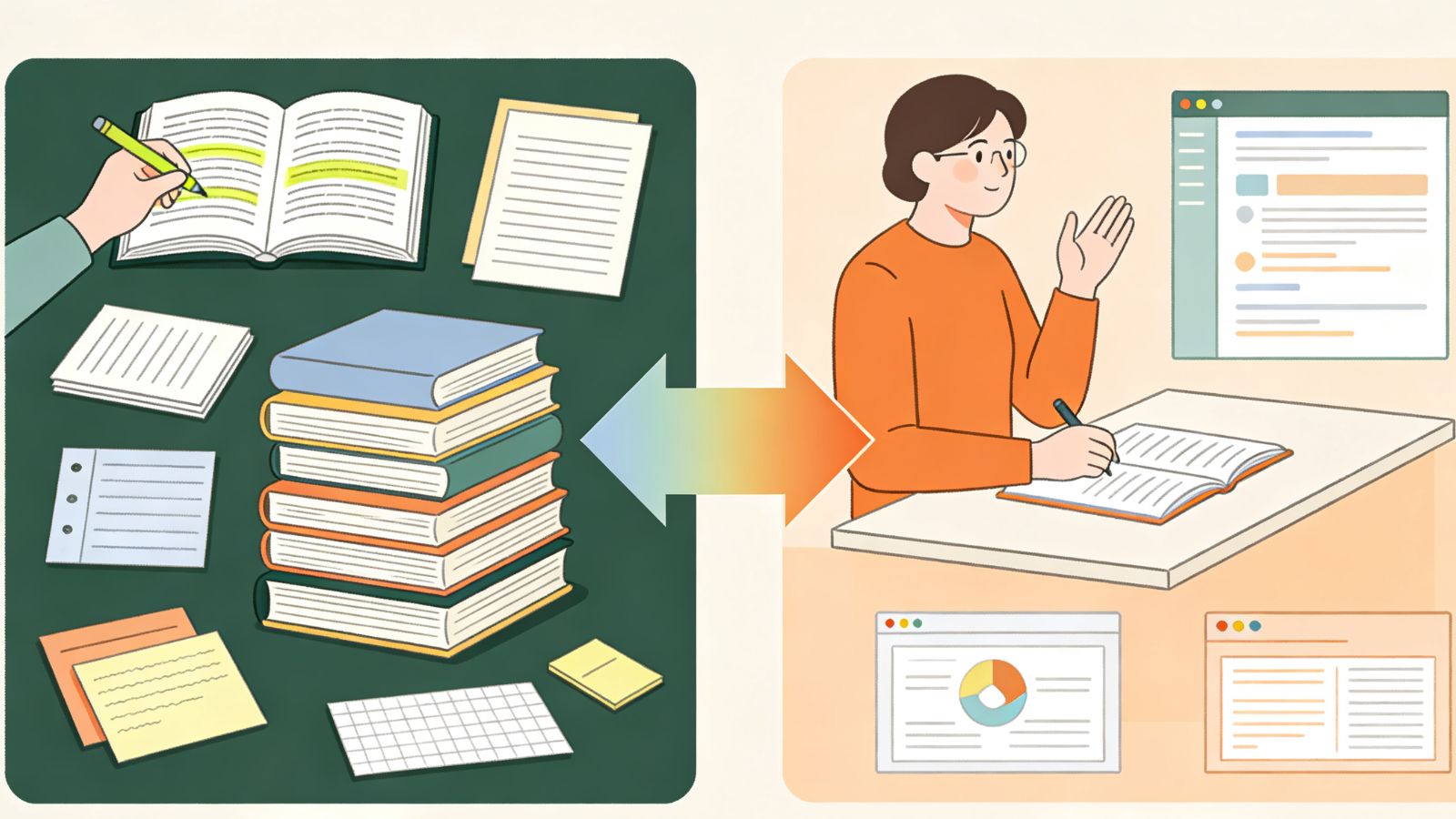
Active recall and passive review are often described as competing learning methods, but they serve different purposes. Passive review helps learners encounter new information and build initial understanding, while active recall improves the ability to retrieve and apply knowledge later. Effective learning usually comes from knowing how to combine these approaches rather than choosing one and ignoring the other.
Research in cognitive psychology has shown that retrieval practice can improve long-term retention. Studies on the testing effect, including influential work by Henry Roediger and Jeffrey Karpicke, found that actively recalling information can produce stronger delayed memory performance than repeated studying alone. Their findings helped explain why a learning method that feels more difficult can sometimes produce better results over time.
Passive review remains popular because it feels productive and organized. Reading notes again, watching a lecture a second time, reviewing highlighted sections, or looking through completed examples can make difficult material appear easier. During the early stages of learning, this exposure is valuable because it helps learners become familiar with unfamiliar ideas and terminology.
The challenge is that familiarity does not always mean the information can be used independently. When learners see the answer directly in a textbook or set of notes, their brains are performing recognition rather than retrieval. Recognition is useful, but it requires less mental effort than producing an answer without assistance.
This difference appears across academic and professional settings. A programming student may understand a code example while reading documentation but struggle to create a similar solution from scratch. A law student may remember a legal definition but find it difficult to determine how that rule applies to a new situation. A language learner may recognize vocabulary while reading but hesitate when trying to use those words during conversation.
Passive review should therefore be considered a foundation rather than a complete learning strategy. Reading, explanations, and examples help create understanding, but stronger retention usually develops when learners later practice retrieving and applying that information without relying on the original source.
Active recall changes the learning process by requiring the learner to attempt retrieval before checking the answer. Instead of repeatedly showing the brain information, it creates a situation where the brain must search for that information and reconstruct what it knows.
A simple example is closing a textbook after reading a chapter and writing down the main ideas from memory. More advanced forms include answering practice questions, explaining a technical process without notes, solving problems independently, or teaching a concept to another person.
The benefits of retrieval practice have been demonstrated through decades of cognitive psychology research. Roediger and Karpicke’s 2006 study on test-enhanced learning showed that students who practiced retrieving information often demonstrated stronger long-term retention than students who repeatedly studied the same material. The research also highlighted an important learning challenge: people often feel more confident after rereading, even when retrieval practice would produce better memory later.
The value of active recall comes from its connection to real-world performance. Exams require students to produce answers, engineers must remember procedures while solving problems, and professionals must access knowledge while making decisions. Practicing retrieval during learning prepares people for situations where information must be available without direct assistance.

Not every self-test creates effective active recall. Many learners believe they are testing themselves but are actually checking recognition. The quality of the question determines whether the brain is practicing simple identification or deeper retrieval and application.
For example, a beginner learning Python might ask, “What is a Python dictionary?” This question can confirm that the learner remembers a definition, but it does not show whether they can use the concept. A stronger question would ask, “Write the Python code needed to safely retrieve a value from a dictionary when the requested key may not exist.” This requires recalling syntax, understanding the problem, and applying the knowledge.
The same principle applies in other areas. A language learner gains more from creating sentences with a new grammar structure than from matching words with translations. A law student develops stronger understanding by explaining why a legal rule applies to a specific scenario rather than simply repeating the wording of a textbook.
The strongest retrieval questions resemble the situations where knowledge will eventually be used. Instead of asking only “What is this?” learners should often ask “How does this work?”, “Why does this happen?”, and “How would I use this in a real situation?”
The popularity of active recall has sometimes led people to believe that passive review should be avoided completely. That approach overlooks an important part of learning: people usually need exposure and explanation before they can effectively retrieve information.
When someone begins learning a completely new subject, reading explanations, studying examples, and watching demonstrations help build the mental framework needed for future practice. A beginner learning a programming framework, for example, may need to understand basic concepts and review sample projects before attempting independent problem-solving.
The transition from passive review to active recall is where many learners improve their results. After gaining initial understanding, they can close the documentation, rebuild a small project, explain concepts from memory, or answer questions without looking at their notes.
A balanced approach follows a natural learning sequence: first understand the material, then practice retrieving it, and finally apply it in realistic situations. Passive review and active recall are most effective when they support each other instead of being treated as completely separate methods.
Many beginners try active recall and abandon it because the experience feels uncomfortable. They may struggle to answer questions, forget information quickly, or feel that the method is slower than rereading. However, these difficulties often indicate that the learner is identifying gaps rather than failing at learning.
One common mistake is creating low-quality flashcards. A card asking “What is TCP?” with the answer “Transmission Control Protocol” mainly tests a definition. A stronger card might ask, “Why would an application choose TCP instead of UDP when reliable data delivery is important?” This requires understanding how the concept works rather than simply remembering a term.
Another issue is using retrieval practice before building enough background knowledge. Someone cannot effectively recall information they have never understood. Active recall works best after learners have gained basic familiarity through explanations, examples, or instruction.
Feedback is also essential. Retrieval attempts become valuable when learners check their answers, correct mistakes, and understand missing information. Guessing repeatedly without reviewing errors can reinforce confusion instead of improving knowledge.
Active recall becomes more effective when combined with spaced repetition. Instead of reviewing information repeatedly during one long study session, learners revisit material over several days and attempt retrieval at different intervals. This approach helps strengthen memory by repeatedly practicing access to information.
Tools such as Anki, RemNote, and other flashcard systems can help organize this process, but the software itself does not create learning. A poorly designed deck can still encourage shallow memorization if cards only ask for definitions instead of requiring explanation or application.
Effective flashcards usually focus on meaningful retrieval. Instead of asking, “What does this programming function do?” a stronger card might ask, “When would this function be a better choice than another approach, and what problem does it solve?” The second question requires the learner to connect information and make a decision.
A practical weekly study cycle might begin with learning new material and creating recall questions on the first day. The next day, the learner attempts to answer without notes and records weak areas. Several days later, those difficult concepts receive another retrieval attempt, followed by a broader review session at the end of the week.
Consider a learner preparing for a difficult certification exam. In a traditional study approach, the learner may spend several weeks reading textbooks, highlighting important sections, and rewriting notes. By the end of the preparation period, the material looks familiar, but practice tests reveal difficulty applying concepts to unfamiliar questions.
A retrieval-based approach would use the same learning materials differently. The learner would still read and study explanations at the beginning, but later sessions would focus on answering questions without notes, explaining difficult topics, and identifying specific weaknesses.
Instead of creating flashcards that only store facts, the learner might design questions that reflect exam situations. Rather than asking, “What is the definition of this concept?” the learner might ask, “How would this concept affect the outcome in this situation?” This creates practice that is closer to actual performance.
The goal is not necessarily to spend fewer hours studying. The improvement comes from changing how those hours are used. Less time is spent repeatedly viewing information, and more time is spent practicing the mental actions required during the real exam.
Active recall is one of the most useful learning techniques supported by cognitive science, but it is not a replacement for understanding, practice, or feedback. Memorizing information without understanding how it connects to larger ideas can create knowledge that is difficult to apply.
Different skills require different forms of learning. A software developer needs factual knowledge and experience building systems. A musician needs theoretical understanding and repeated physical practice. A healthcare professional needs both medical knowledge and the ability to make decisions in complex situations.
The strongest learners combine multiple approaches. They use explanations to understand new ideas, retrieval practice to strengthen memory, and practical experience to develop flexible skills.
The purpose of learning is not simply to store more information. Useful knowledge is information that remains accessible and can be adapted when circumstances change.
Many learners judge progress by visible activities such as the number of pages read, notes created, or hours spent studying. These measurements can be useful, but they do not always show whether knowledge is available when it matters.
A more effective approach is to regularly test whether you can explain a concept, solve a problem, or apply information without looking at your notes. This reveals weaknesses earlier and helps direct study time toward areas that need improvement.
When building a study routine, start with understanding, add regular retrieval practice, and use spaced review to maintain knowledge over time. The goal is not to make studying feel easier; it is to make learning more reliable.
For readers interested in improving their study systems, related topics include “How to Design High-Retention Anki Decks” and “Spaced Repetition Strategies for Long-Term Learning.”
The purpose of studying is not simply to make information appear familiar during review. The real value of learning comes from being able to explain ideas, solve problems, and make decisions when the original materials are no longer available.
Passive review provides the foundation needed to understand new information, while active recall strengthens the ability to retrieve and apply that knowledge. When combined with spaced repetition, feedback, and practical experience, retrieval-based learning can help create stronger and more durable knowledge.
The most effective learners are not always the ones who spend the most time studying. They are often the ones who spend more of that time practicing the exact mental actions they will need later.